Why it matters
A blood bank has no room for an unverified step. A unit must be tested, typed, stored within temperature limits, matched to one patient and checked again at the bedside. Each handover is a place where an error can enter.
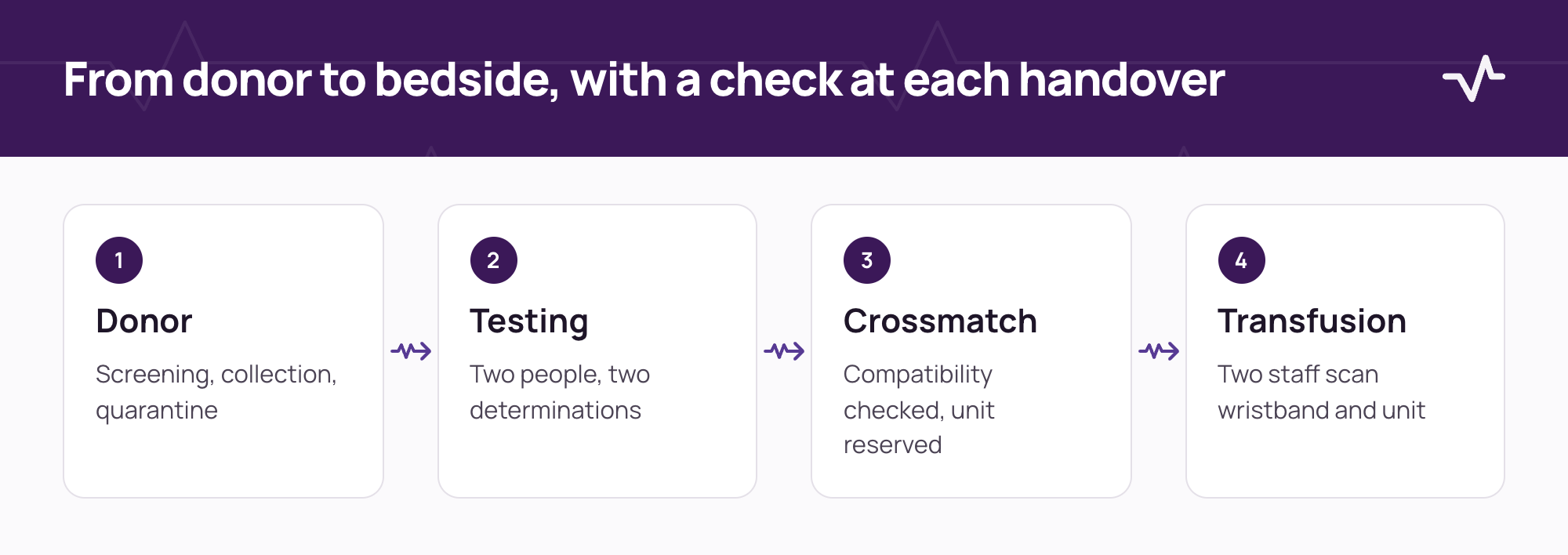
The Ventrecs blood bank module makes each handover a gate. Units are quarantined until tests pass, groups are confirmed by two independent determinations, a temperature excursion quarantines the units in that storage, and the bedside transfusion needs two staff to scan the wristband and the unit.
- Donor register, screening and collection
- Unit quarantine, testing and release
- Storage temperature log with excursion handling
- Patient typing, crossmatch, issue, return, bedside transfusion and reactions
What it does
Donor side
A donor is screened before a unit exists.
- Donor register with consent and deferral rules
- Pre-donation screening of haemoglobin, weight, blood pressure, pulse and temperature
- Collection creates the unit in quarantine, with a shelf life from the approved component type
Testing and release
A unit is released only when every check is complete.
- Every screening result needs a second person to verify it
- Two independent ABO and Rh determinations by different people
- A reactive marker discards the units, defers the donor and raises a counselling task
Cold chain and inventory
The storage is part of the record.
- Storage units with temperature limits and a reading log
- An out-of-range reading marks an excursion and quarantines every unit in it
- Units expire automatically and lapsed reservations return to stock
Crossmatch, issue and transfusion
The unit is tied to one patient from the start.
- Patient typing confirmed by two concordant determinations from different samples
- Electronic crossmatch only with a confirmed group and a negative antibody screen
- Issue checks, emergency uncrossmatched issue with an authorising physician, and returns with a time limit
Reactions
A reaction stops the transfusion and starts an investigation.
- Recording a reaction discards the implicated unit and quarantines co-components of the same donation
- An investigation task for the supervisor
- Imputability and the report to the haemovigilance authority recorded by the supervisor
Built-in safeguards
Blood bank software is a regulated activity. Ventrecs implements widely published safeguards. The blood bank medical director approves every configuration value, and the system is validated against local regulation and accreditation requirements before real donors or patients are involved.
Questions we are asked
Does it replace the medical director's approvals?
No. The medical director approves component types, marker rules and excursion clearance. Nothing is released on defaults.
How does the bedside check work?
Two different staff members independently scan the patient wristband and the unit. Compatibility is re-checked, baseline observations are required, and the transfusion must start within a set time of issue or a reason is recorded.
What happens after a transfusion reaction?
Recording the reaction stops the transfusion, discards the implicated unit, quarantines co-components of the same donation and opens an investigation task. The supervisor records imputability and the report to the haemovigilance authority.
Is it ready for use in any country?
The module is configured per country and per facility. It must be approved by the medical director and validated against local regulation and accreditation before use.
Talk to us about your setup
Tell us about your facility and current systems. We will reply within one working day.