Why it matters
In most Middle East facilities a large share of revenue depends on payer rules: what a plan covers, what needs pre-authorisation, what the patient owes at the desk. Handled by hand at the front desk, those rules produce rejected claims and disputed bills.
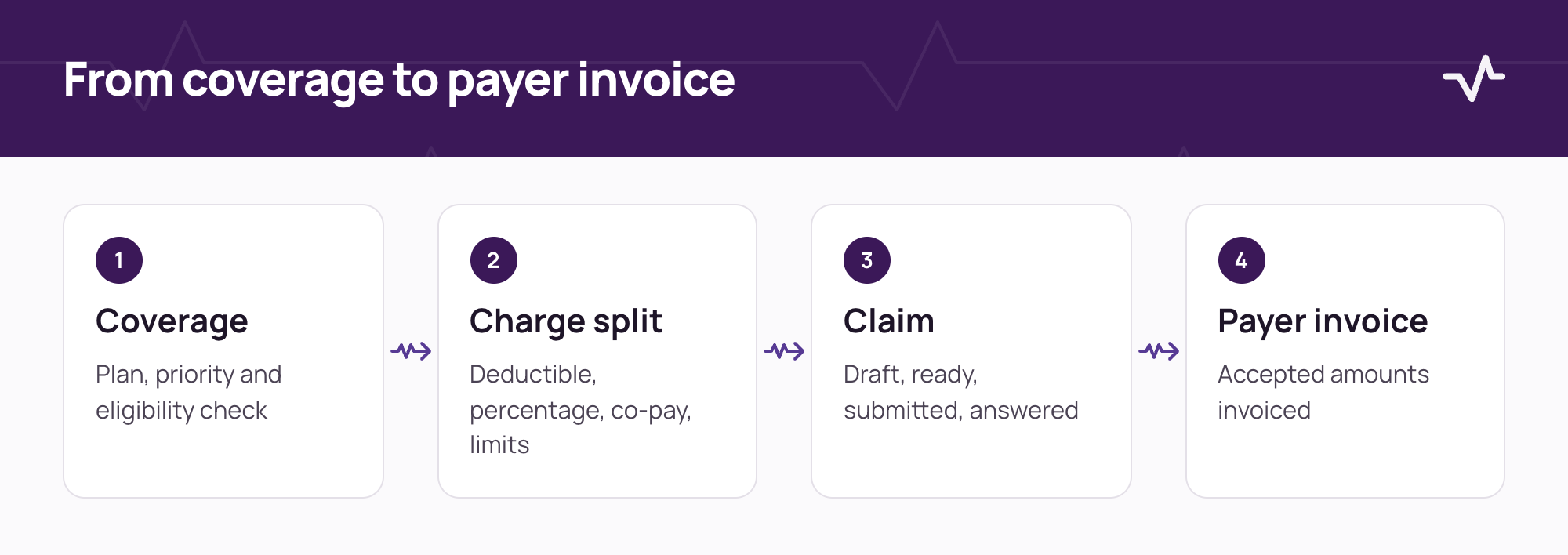
The Ventrecs insurance module holds the rules as configuration. Payers, plans and benefit rules decide how each charge is split, pre-authorisation can gate a service, and the claim is built from the same charges.
- Payers, plans and benefit rules
- Several coverages per patient, by priority
- Pre-authorisation, eligibility checks and claims
- Four payment flows, and insured sales at the pharmacy till
What it does
Payers and plans
A plan is the payer's benefit package, held as data.
- Payer percentage, fixed co-pay, annual deductible and annual limit
- Benefit rules by service kind, product or category: exclude, set a percentage, require pre-authorisation or cap the amount
- Approved plans are immutable; a change is a new version so past claims keep their terms
Coverage and eligibility
The patient's policy is verified before it is used.
- Several coverages per patient with a priority (primary, secondary)
- Eligibility check by manual reference, a generic REST connector or a FHIR R4 CoverageEligibilityRequest connector
- An eligible answer verifies the coverage for a validity window
Charge split and pre-authorisation
Each service is split by the plan's rules.
- Deductible first, then the payer percentage minus the co-pay, capped per service and by the remaining annual limit
- Pre-authorisation request, approval number, validity dates and an amount cap
- When it is missing, the flow decides: hold the claim or move the share to the patient
Claims and payments
The claim is built from the encounter's charges.
- One draft claim per encounter and coverage, with a lifecycle from draft to invoiced
- Export as CSV for portal upload or as a FHIR R4 Claim
- Apply the payer's response, then raise the payer invoice for accepted amounts
Desk payment flows and pharmacy
The front desk follows a rule set, not memory.
- Self-pay, insured with co-pay at the desk, insured settled at discharge, and credit account
- Insured pharmacy sales with a payer-share payment method; the server recomputes the split
- Elective surgery blocked until a required pre-authorisation exists
Built-in safeguards
Questions we are asked
Does it include the national e-claim formats?
National claim and exchange schemes have their own specifications, credentials and onboarding. Ventrecs delivers them as interface adapters per jurisdiction, scoped and tested per project. The generic REST and FHIR R4 connectors cover payers that offer them.
Can a patient have more than one insurer?
Yes. Coverages are applied in priority order, so the secondary payer sees what the primary left.
What if pre-authorisation is missing?
The payment flow decides. By default the service continues and the claim cannot be marked ready until it is authorised; alternatively the payer's share moves to the patient.
Does it work at the pharmacy counter?
Yes. The point of sale has a payer-share payment method, and the server validates the split before the sale is accepted.
Related guides
Talk to us about your setup
Tell us about your facility and current systems. We will reply within one working day.