Skip to Content

Biomedical maintenance software built around the WHO CMMS framework

A computerized maintenance management system for medical equipment, structured on the WHO Medical device technical series: inventory, lifecycle, work orders, downtime and recalls on one record.

WHO, 2011WHO Medical device technical series · Computerized maintenance management system
WHO, 2011

Built around the WHO CMMS framework

The World Health Organization describes what a computerized maintenance management system (CMMS) for medical equipment should contain: an equipment inventory, spare parts, maintenance and contract modules, and the screens and reports that tie them together. Ventrecs follows that structure for the parts that belong in a hospital system, and says plainly where a part sits elsewhere.

The reference documentComputerized maintenance management systemWHO Medical device technical series · 2011 · ISBN 978 92 4 150141 5
WHO CMMS element
What the WHO document describes
In Ventrecs
Equipment inventory module (section 3.2.1, Appendix A)
The core of a CMMS: equipment type, model, manufacturer and location, with stored default values such as risk level and inspection and preventive maintenance (IPM) frequency.
A device-type catalogue with default risk class, PM interval and calibration rules. Equipment records carry asset number, manufacturer, UDI, facility, department, room, clinical owner and maintenance responsibility, and can map an external nomenclature code.
Equipment lifecycle (Figure 1)
Reception, installation, acceptance, training, operation, maintenance, then decommissioning or replacement.
A controlled lifecycle: receipt, acceptance checks (documents, electrical safety, performance, operator training), technical and clinical sign-off, commissioning, and decommissioning with a request and an approval.
Maintenance module (section 3.2.3, Figure 3)
Inspection and preventive maintenance and corrective work orders, with priority set by equipment risk.
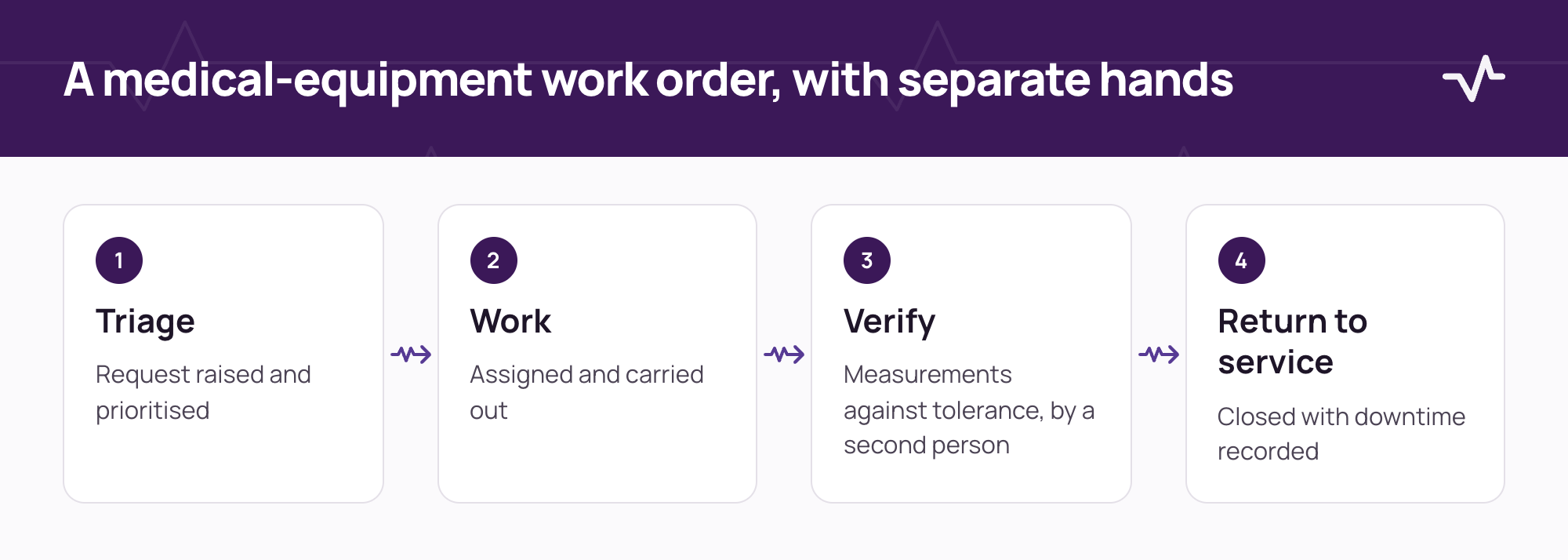
A server-enforced work-order flow: triage, assignment, work, verification, return to service and closure, with planned maintenance generated from the device-type defaults.
Performance indicators and quality control (Figure 1)
Downtime monitoring, equipment and supplier performance, and quality control.
Downtime recorded per equipment, and measurements with tolerance and automatic pass or fail, including the first as-found reading and the test instrument's calibration due date.
Recalls and alerts (Table 2, regulatory reports)
Identifying the equipment affected by hazard and recall alerts.
Safety alerts and recalls matched to equipment by device type, manufacturer and model, with an outcome for each device and a link to its work order.
Staff and access (Table 1)
Staff records with an access level.
Role-based access, and segregation of duties between the person who works and the person who verifies.
Spare parts and contract modules (sections 3.2.2 and 3.2.4)
Spare parts stock and ordering, and tracking of externally provided maintenance services.
Maintenance responsibility is recorded per equipment: in-house team, contracted provider, manufacturer, department or shared service. Spare parts stock and service contracts run on Odoo's Inventory, Purchase and Maintenance apps and are scoped per project.
Screens and reports (section 3.3, Table 2)
An equipment history screen, and list, summary, activity, workflow, financial and regulatory reports.
The equipment record shows its work orders, downtime and alerts. Lists, pivots and exports use Odoo reporting, and further reports are scoped per project.

Implementation follows the WHO sequence

The WHO document sets out seven phases for adopting a CMMS. A Ventrecs deployment schedules the same work: scoping the need, collecting equipment data, configuring device-type defaults and roles, entering the inventory and training the people who use it.

  1. 1Evaluation
  2. 2Selection
  3. 3Data collection
  4. 4Installation
  5. 5Configuration and customisation
  6. 6Data entry
  7. 7Training
Aligned, not certified

The module follows the WHO guidance. It is aligned with that document. It is not a WHO-certified product, and WHO does not endorse Ventrecs.

Why it matters

A hospital maintains two kinds of equipment. A laptop or a chair needs a repair. An infusion pump or a ventilator needs a repair, a measured check against tolerance, a decision to return it to service, and a record of how long it was unavailable.

The Ventrecs biomedical maintenance module extends Odoo's Maintenance app. General equipment keeps the standard behaviour untouched. Medical equipment follows a controlled lifecycle and a server-enforced work-order flow, organised the way the WHO describes a CMMS.

At a glance
  • An equipment inventory with device-type defaults
  • Controlled lifecycle: receipt, acceptance, commissioning, decommissioning
  • Work orders from triage to closure
  • Measurements, downtime, recalls and planned maintenance
Biomedical maintenance

What it does

A medical-equipment work order, with separate hands

Medical and general equipment

One register, two behaviours.

  • General equipment keeps the native Odoo Maintenance behaviour
  • Medical equipment carries a clinical safety status of its own
  • A device-type catalogue to classify the equipment

Lifecycle

The equipment passes controlled stages.

  • Receipt and acceptance
  • Commissioning before clinical use
  • Decommissioning with a record

Work orders

The flow is enforced on the server.

  • Triage, assignment, work, verification, return to service and closure
  • Segregation of duties between those who work and those who verify
  • Planned maintenance generated from a schedule

Measurements, downtime and alerts

The record shows whether it is safe to use.

  • Measurements with tolerance and automatic pass or fail
  • Downtime tracking for each piece of equipment
  • Safety alerts and recalls linked to the equipment affected
Biomedical maintenance

Built-in safeguards

Segregation of dutiesThe person who carries out the work cannot be the person who verifies and returns the equipment to service.
Pass or fail is computedA measurement outside its tolerance fails. It is not left to a free-text note.
Clinical safety statusEquipment has a safety status that is separate from its maintenance state, so a device can be marked unsafe for clinical use.
Recalls reach the deviceA recall or safety alert is matched to the equipment it affects, and each device has its own outcome.
Biomedical maintenance

Questions we are asked

Which WHO document is this based on?

The WHO Medical device technical series publication Computerized maintenance management system (WHO, 2011, ISBN 978 92 4 150141 5). The page above maps each part of it to the module.

Is the module WHO-certified?

No. It is aligned with the WHO document. WHO does not certify or endorse software products.

Does it replace Odoo Maintenance?

No. It extends it. General equipment behaves exactly as in standard Odoo, and medical equipment gains the controlled lifecycle and work-order flow.

Are spare parts and service contracts included?

They are not part of the biomedical module itself. They run on Odoo's Inventory, Purchase and Maintenance apps and are scoped per project, with the maintenance responsibility recorded on each equipment.

Talk to us about your setup

Tell us about your facility and current systems. We will reply within one working day.