Skip to Content
Ventrecs Lab

Laboratory information system, from specimen to verified result.

A laboratory information system (LIS): catalogue, specimen workflows, labels, orders, results and critical-result acknowledgement, connected to the ordering clinician and the patient, with instrument interfaces and a review layer of rules and optional AI that never decides.

For lab directors, technologists and phlebotomy teams.

Key workflow

How a result moves

01

Order

Requested from the patient record.

02

Specimen

Collected, labelled and tracked.

03

Analyser / result

Results entered or received from the instrument.

04

Verification

Reviewed and verified by the lab.

05

Delivery

Released to clinician and patient, critical values first.

Rules first

Critical and implausible results are caught on arrival

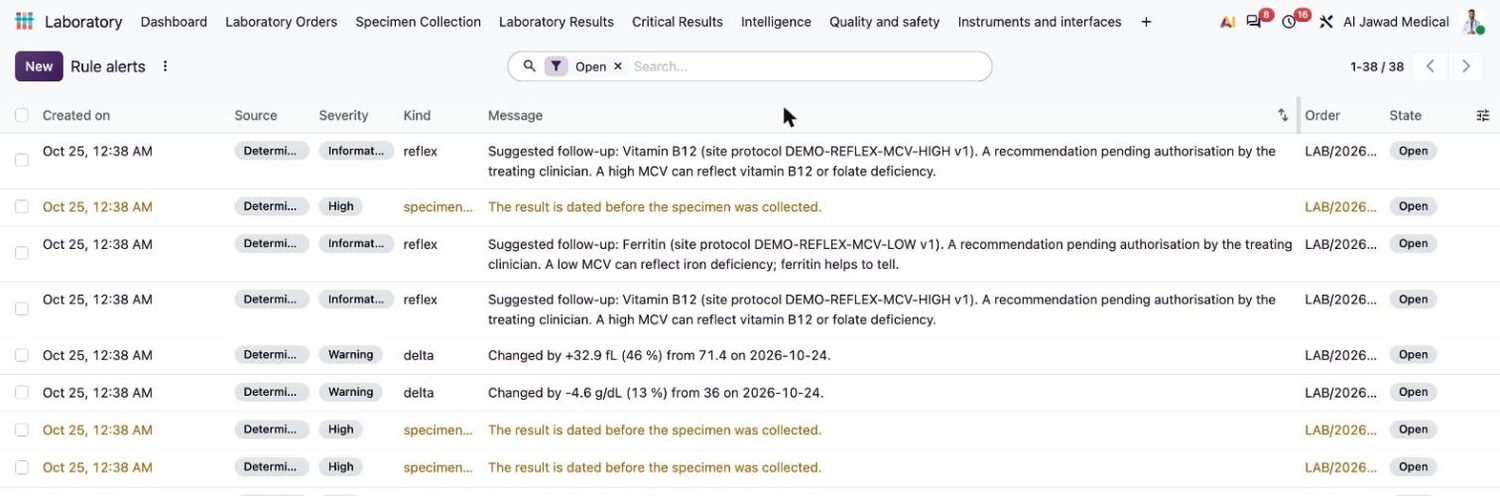
Approved, versioned rules run the moment a value is entered or received: critical values, implausible values, change since the last result, specimen age and suggested follow-up tests. They run with the AI switched off.

Approved and versioned
A rule set is approved by the laboratory director before it is active, and a different person must approve what someone else submitted.
Follow-up stays a recommendation
A reflex suggestion, such as a vitamin B12 test after a high MCV, is only a recommendation until the clinician authorises it.
Nothing is released by an alert
An alert never releases, changes or hides a result.
Rule alerts in Ventrecs Lab: critical values, change since the last result, specimen age and suggested follow-up tests
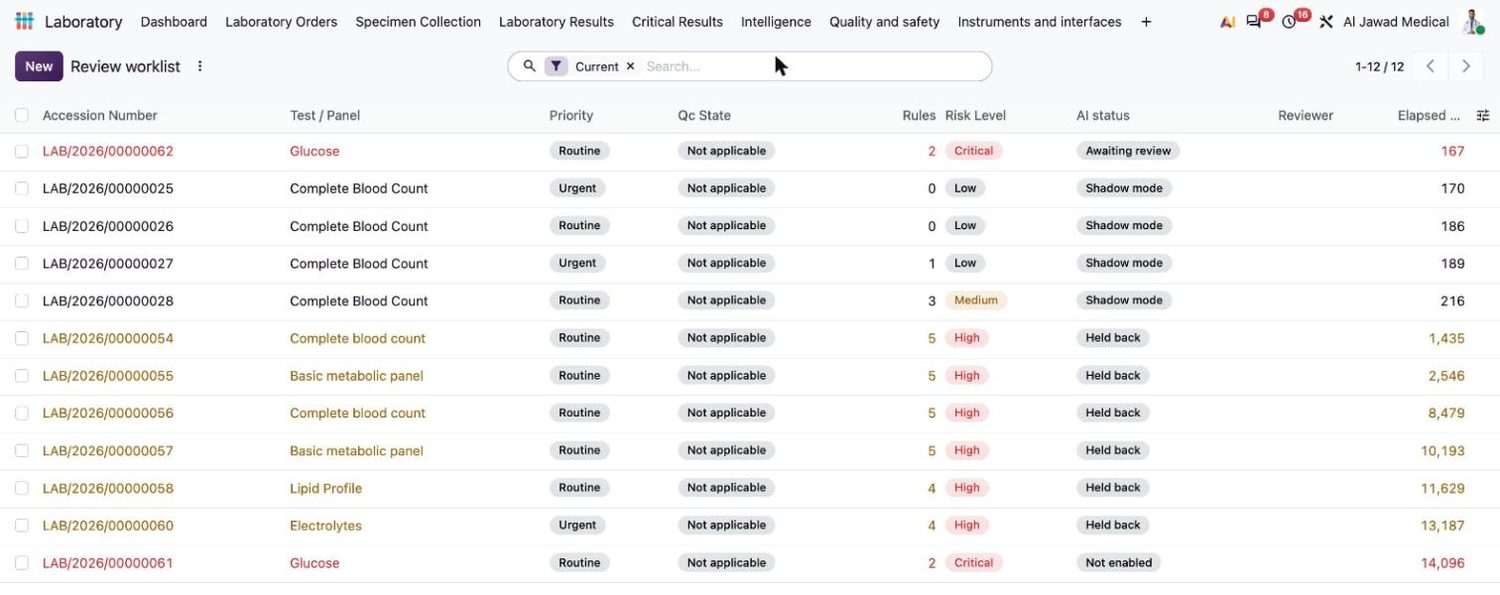
The laboratory review worklist: risk level, rule alerts and the status of the model for each order
Review worklist

One worklist for what needs a person

Every checked order is a case with its rule findings, the facts that were checked and, where your laboratory allows it, a plain-language suggestion for a named reviewer to accept, change, reject or defer.

AI is optional and off by default
Each facility is set to rules only, shadow (the model runs and is measured but nobody sees it) or supervised (suggestions go to named reviewers).
Unverified until a reviewer decides
Suggested text is marked unverified, cannot release or change a result, and needs a reason to be modified, rejected or deferred.
Onto the signed report
An accepted text can be printed on the signed laboratory report with its author and source, and is withdrawn automatically if the result is amended.
Fit to interpret

It says no when the data cannot be trusted

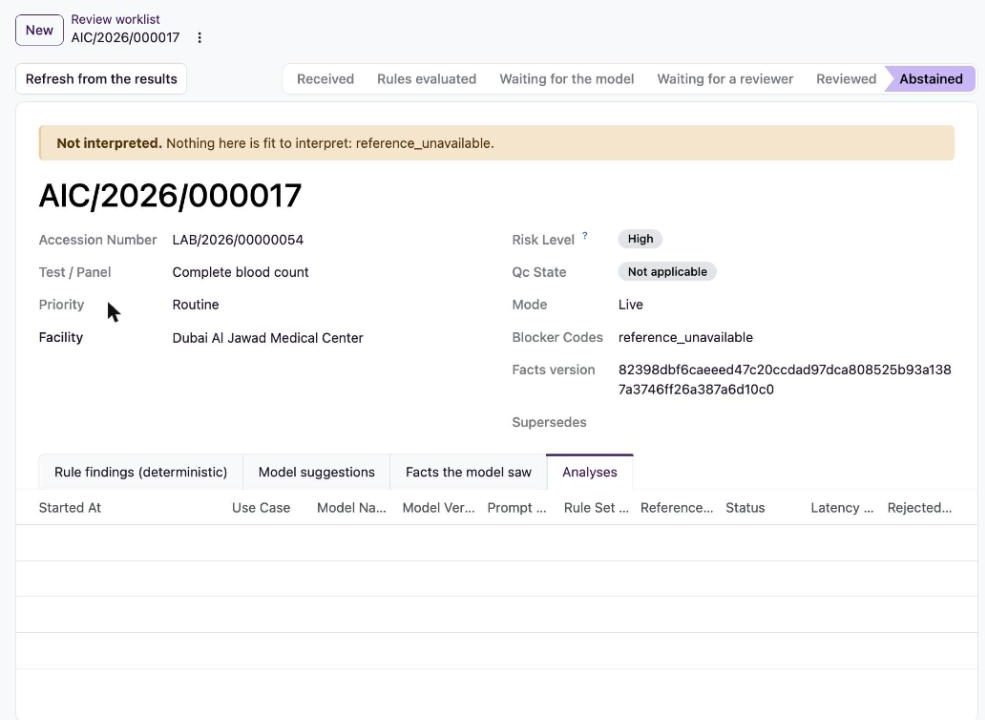
A result with an unclear unit, no reliable reference interval, a failed or missing quality-control run, or a specimen problem is not interpreted. The case says exactly why.

Named reasons
Unit ambiguous, reference unavailable, quality control invalid or missing, specimen mismatch or rejected, value unverified, missing context and unsupported test.
Mismatches are quarantined
A specimen or patient mismatch quarantines the case until it is resolved.
Results are handled as before
The laboratory still verifies and releases the value as usual. What is held back is the interpretation.
A laboratory case that was not interpreted, with the banner and the blocker code that explain why
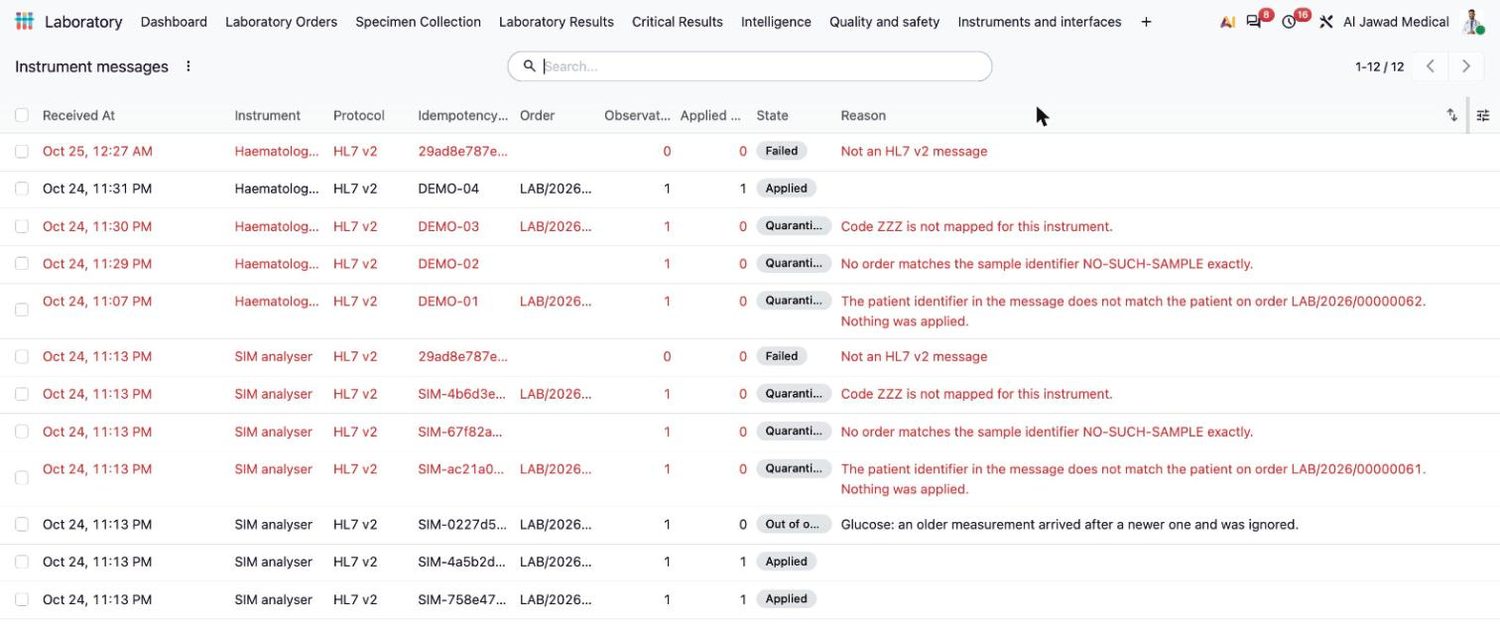
Instrument messages in Ventrecs Lab: applied, quarantined, failed and out of order, each with its reason
Instruments

Analyser results in, doubtful ones held for a person

Analysers send results as HL7 v2 or ASTM E1394 messages. Each message is matched to the instrument, the order and the test, and applied only when it is safe.

Mapped and gated
Instrument test codes map to your tests with a default unit, and a failed or missing quality-control run blocks interpretation of the results.
Quarantine, don't guess
A message for the wrong patient, an unknown sample or an unmapped test code is quarantined with the reason, and nothing is applied.
Duplicates and old values
The same message twice is applied once, an older measurement after a newer one is ignored, and a signed-off result is never overwritten.
Governance and audit

Every change approved, every decision on record

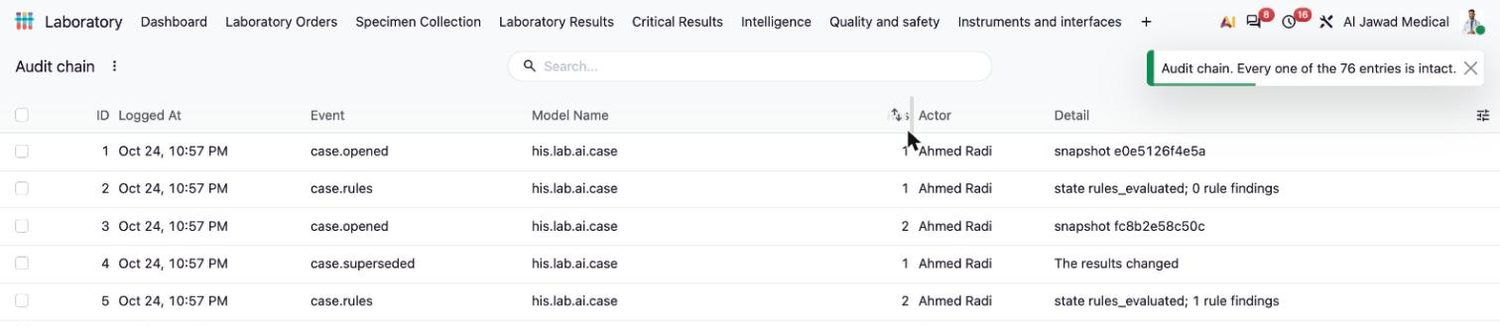
Rules, models, prompts, references and unit conversions move from draft to approved to active, and each decision names its reviewer. A chained audit log can be checked from the screen.

A full checklist for external models
A hosted model needs a signed data-processing agreement, a no-training term, a security assessment, a transfer-impact review, validation evidence and an allowed data region before it can be activated. The built-in explainer runs on site.
Nothing identifying leaves
The model sees structured, de-identified facts only.
No automatic training
Feedback datasets need the approval of a director and a privacy officer, are exported de-identified, and nothing is trained automatically.
The audit chain of Ventrecs Lab, verified from the screen: every entry intact
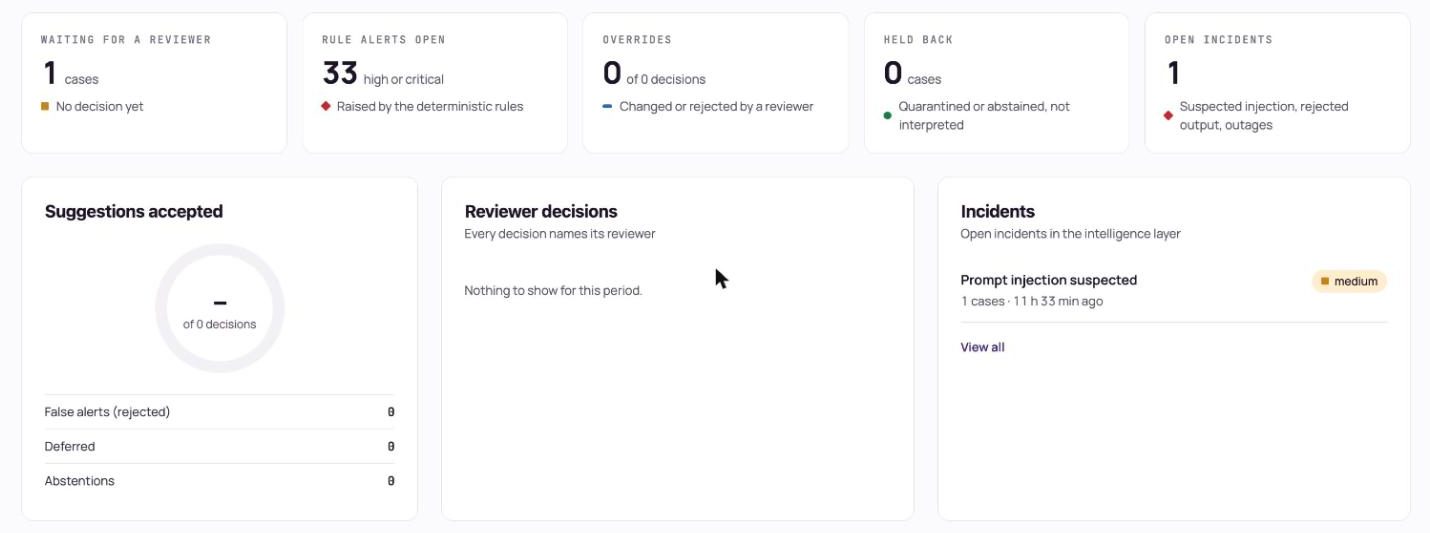
The review row of the Laboratory dashboard: cases waiting for a reviewer, rule alerts open, overrides, held-back cases and open incidents
Quality overview

Know how the review layer is behaving

The Laboratory dashboard has a review row: cases waiting for a reviewer, rule alerts open, overrides, held-back cases and open incidents, with the decisions and incidents below.

Overrides and false alerts
Model performance shows how suggestions were decided by facility, instrument, use case, sex and age band.
Incidents with an owner
A suspected prompt injection, a rejected model output or an outage is logged as an incident with an owner and a state.
A role for quality officers
A quality officer reads the audit, incident and performance screens without touching a result.
Capabilities

LIS software built around the way a laboratory actually works.

Catalogue

  • Governed tests and panels
  • Lab-director approval
  • Pricing by payer

Specimens

  • Collection workflow
  • Specimen labels & wristbands
  • Specimen tracking

Results

  • Result entry & verification
  • Critical-value alerting
  • Critical-result acknowledgement

Reports & delivery

  • Bilingual lab report
  • QR verification
  • Secure patient result access

Result intelligence

  • Rules on arrival
  • Held-back results with reasons
  • Review worklist
  • Reviewer decisions and report comments

Instruments

  • HL7 v2 and ASTM results
  • Test mapping
  • Quality-control gating
  • Quarantine of doubtful messages

Governance

  • Approved rule sets
  • Optional, governed AI
  • Audit chain
  • Incident log

Patient result access

A verified result prints as a bilingual report with a QR code and a one-time PIN. The patient scans it, enters the PIN and date of birth, and reads the result. No account, no app.

  • 01Single-use PIN; repeated wrong attempts lock it
  • 02Optional release delay, so the clinician can call first
  • 03Sensitive results are only ever disclosed in person
Patient result accessPatient result access
Printed lab report and patient sign-in on mobile
Integrations

Connects to instruments, printers and the wider record.

All integrations →
Label & wristband printers (Zebra ZPL)
Results exchange (FHIR R4)
Laboratory analysers & middleware
Reference laboratories
Laboratory questions

Questions about Ventrecs Lab

What is Ventrecs Lab?

A laboratory information system (LIS) in the Ventrecs platform: test catalogue, specimen workflows and labels, orders, results and critical-result acknowledgement, instrument interfaces, and a review layer of rules and optional AI.

Does the AI decide results?

No. Rules run first, with the AI switched off. A facility can run rules only, shadow mode (the model runs and is measured but nobody sees it) or supervised mode (suggestions go to named reviewers). A suggestion is marked unverified, cannot release or change a result, and needs a reason from the reviewer to modify, reject or defer it.

What do the rules check?

Critical values, implausible values, change since the last result, specimen age and suggested follow-up tests. A follow-up test is only a recommendation until the clinician authorises it. Rule sets are versioned and approved by the laboratory director before they are active.

When is a result not interpreted?

When the unit is ambiguous, no reliable reference interval exists, quality control is invalid or missing, the specimen is mismatched or rejected, the value is unverified, context is missing or the test is unsupported. The case states the reason. The laboratory still verifies and releases the value as usual.

How do analysers connect?

Analysers send HL7 v2 or ASTM E1394 messages. Each message is matched to the instrument, the order and the test, with test codes mapped to your tests and a failed or missing quality-control run blocking interpretation. Doubtful messages are quarantined with the reason, a duplicate is applied once, an older measurement after a newer one is ignored, and a signed-off result is never overwritten.

How is the intelligence layer governed?

Rules, models, prompts, references and unit conversions move from draft to submitted to approved by the director to active, and each decision names its reviewer. A chained audit log can be verified from the screen. A hosted model needs a signed data-processing agreement, a no-training term, a security assessment and validation evidence before activation, sees only de-identified facts, and nothing is trained automatically.
Plan a laboratory workflow assessment.

See Ventrecs Lab in action