Skip to Content

Laboratory information system for independent laboratories

From the order to a verified, delivered result: specimens labelled and tracked, results reviewed, critical values acknowledged.

01
Order
02
Collect
03
Receive
04
Analyse
05
Verify
06
Release
Independent laboratories

Six gates between the order and the report

Each gate records who did what and when. The ones that carry risk are gates, not reminders.

01

Order

Requested from the patient record.

Recorded
Order, patient, facility
02

Collect

The specimen is labelled with a printed label and the patient wristband.

Recorded
Label print log, with a reason for any reprint
03

Receive

Tracked from collection to analysis.

Recorded
Specimen status and location
04

Analyse

Result entered or received from the instrument.

Recorded
Source and value
05

Verify

Reviewed and verified by the laboratory.

Recorded
Verifier, time and any amendment
06

Release

Released to the clinician and the patient, critical values first.

Recorded
Release and acknowledgement
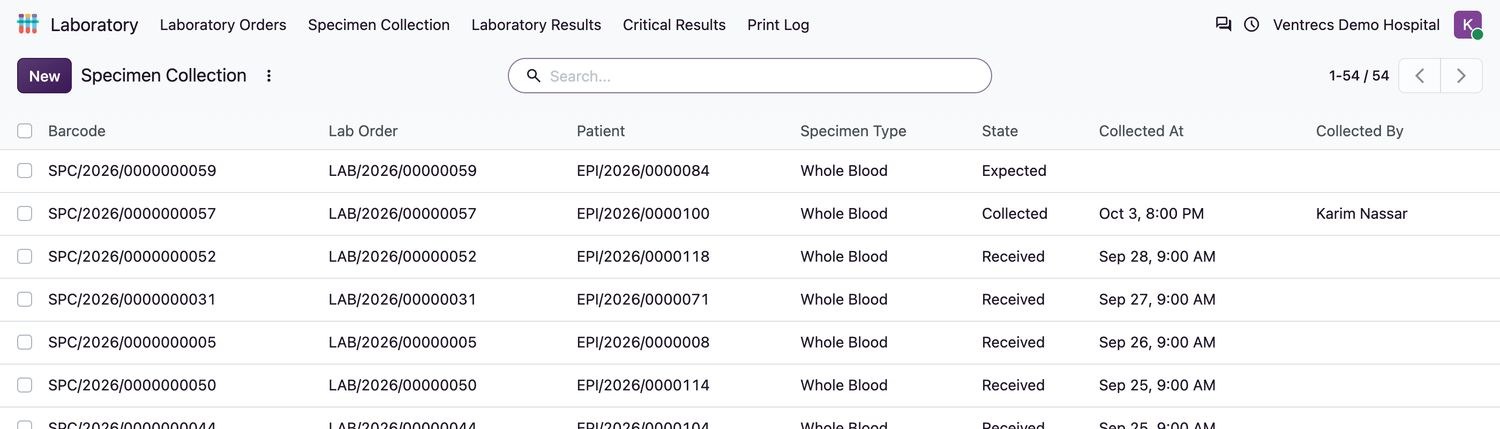
Specimen collection list in Ventrecs Lab with barcode, laboratory order, specimen type, state and collection time
Specimen collection
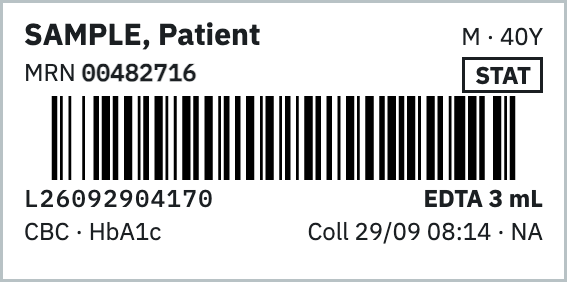
Specimen tube label with barcode, tests and collection time
Specimen tube label
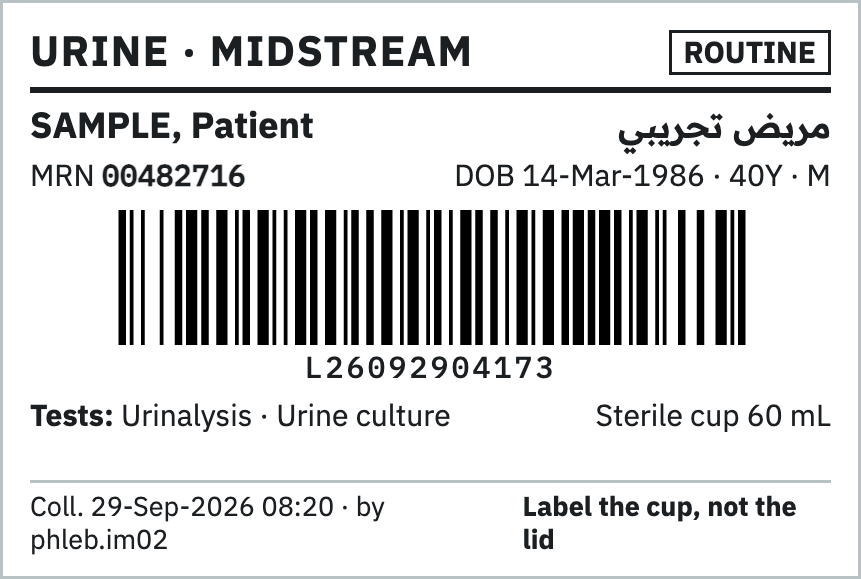
Urine container label with patient details, barcode and tests
Container label

What gets in the way

An independent laboratory is judged on two things: the right result for the right patient, and how fast it arrives. Both depend on small steps that are easy to lose: a specimen that is not scanned, a value copied by hand, a critical result nobody acknowledged.

Ventrecs Lab keeps one governed flow from the order to the delivered report. Each step is recorded, and the steps that carry risk are gates, not reminders.

When a result is critical

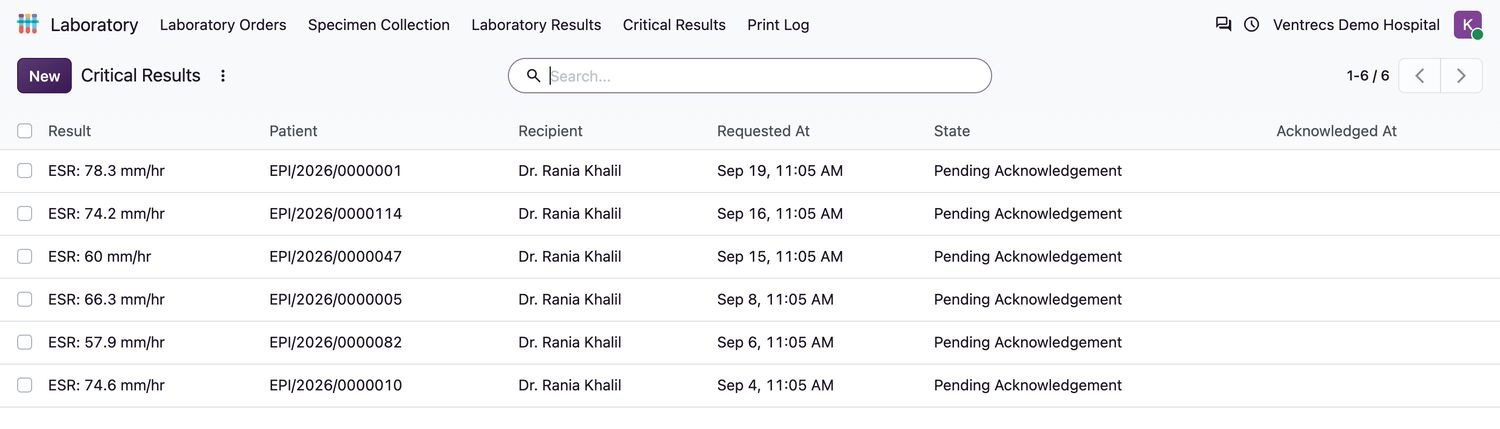
The value is flagged and the clinician is alerted. The alert stays open until someone acknowledges it, and the acknowledgement is recorded. Nothing relies on a phone call that may or may not have happened.

Critical results in Ventrecs Lab pending acknowledgement, with recipient and request time
Critical results awaiting acknowledgement
Independent laboratories

Around the bench

Specimens you can track

Every specimen has an identity from the moment it is collected.

  • Collection workflow with specimen labels and patient wristbands
  • Labels print as ZPL to Zebra network printers, with a PDF fallback
  • Specimen tracking from collection to analysis

Results that are verified before release

A result is entered or received, reviewed, and only then released.

  • Result entry and verification by the laboratory
  • Critical-value alerting and acknowledgement that stays open until someone signs
  • Amendments kept as a record, not overwritten

Analyzer connectivity

Instruments and middleware connect through a governed integration layer.

  • Each analyzer connection scoped, tested and owned per project
  • Durable outbox with retry, a transaction log and reconciliation
  • A written register of protocols, fields and test codes before configuration starts

Reports and patient access

The verified result leaves the laboratory in a form the patient can use.

  • Bilingual report with a QR code and a one-time PIN, no account or app
  • Repeated wrong attempts lock the PIN
  • Optional release delay and in-person disclosure for sensitive results
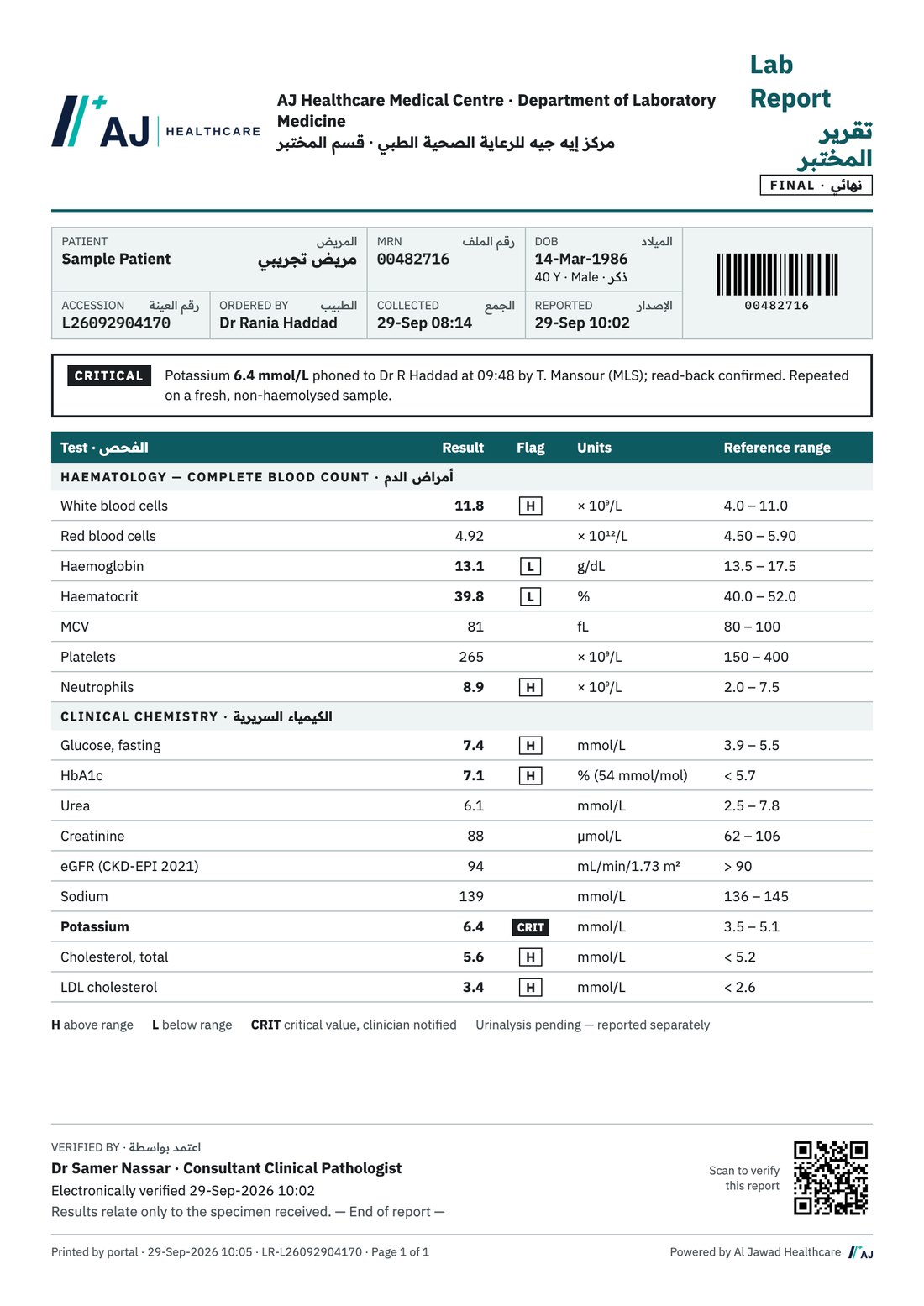
Printed bilingual laboratory report with results, flags, reference ranges, a critical result note and a QR code to verify it
Laboratory report with QR verification
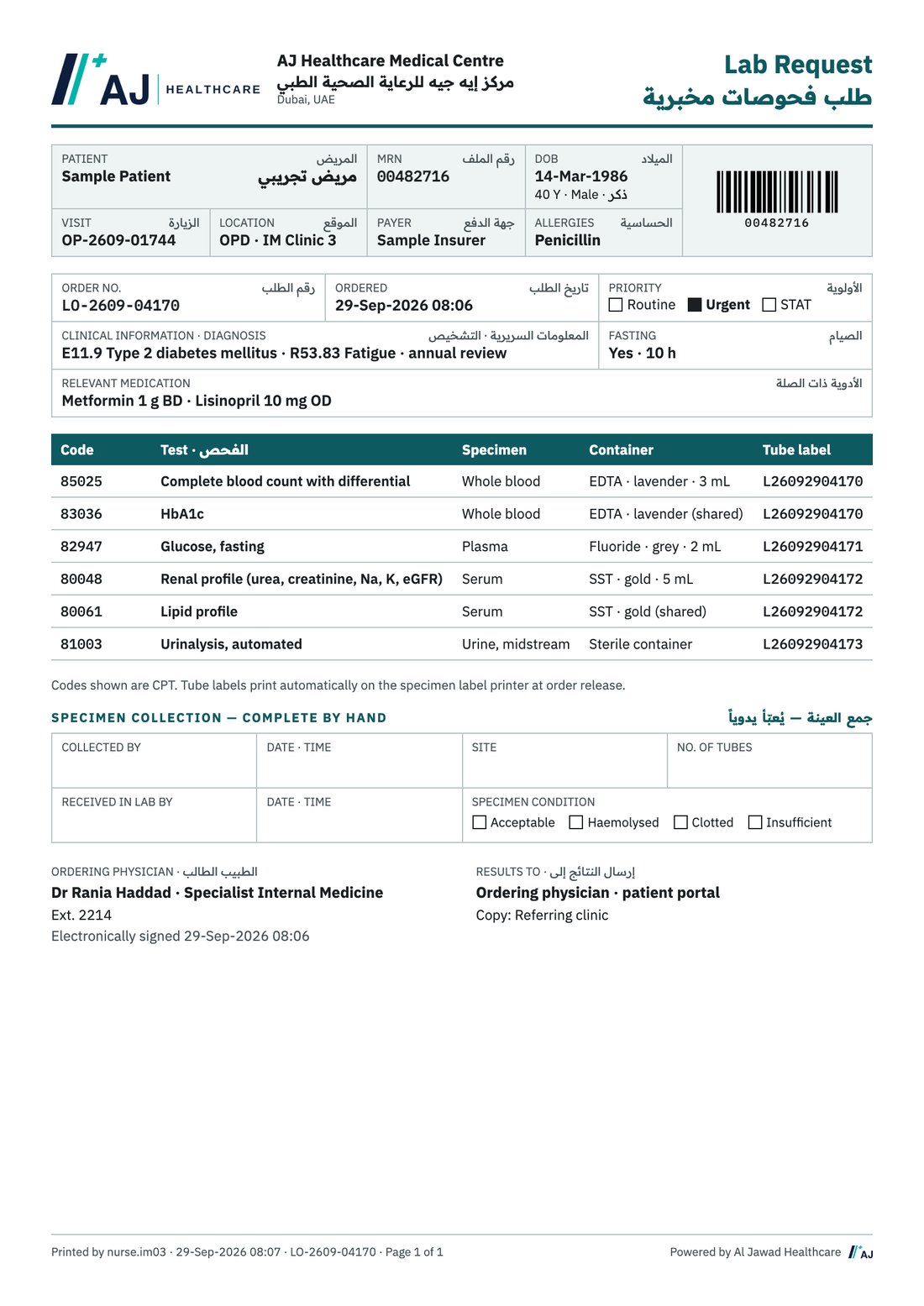
Printed laboratory request with tests, specimen containers and tube labels, in English and Arabic
Laboratory request

Catalogue and pricing

Tests and panels are governed, not typed per order.

  • Governed catalogue of tests and panels with laboratory-director approval
  • Pricing by payer, including referring clinics and corporate accounts
  • Turnaround reporting next to the clinical data

Screens and printouts show synthetic demonstration data and a sample facility.

Integrations commonly required

  • Laboratory analyzers and middleware
  • Label printers
  • Referring clinics and corporate accounts

Each connection is scoped, tested and supported per project. Status is agreed with you before go-live. How integrations are delivered →

Independent laboratories

Questions we are asked

Which analyzers can Ventrecs connect to?

Each analyzer connection is scoped per project: the make and model, the protocol, the direction of data and the test codes are agreed and tested before go-live. We do not publish a blanket list of supported instruments.

How do patients get their results?

A verified result prints as a bilingual report with a QR code and a one-time PIN. The patient scans the code, enters the PIN and date of birth and reads the result, without an account or an app.

What happens to a critical result?

The result is flagged and stays open until a clinician or technologist acknowledges it. The acknowledgement is recorded.

Can we move to Ventrecs without stopping the bench?

Laboratories usually move in phases with parallel running and reconciliation, so results keep flowing while the system changes. See our guide on moving a laboratory without stopping the bench.

Talk to us about your setup

Tell us about your facility and current systems. We will reply within one working day.