What a laboratory management system does
A laboratory management system, often called a laboratory information system (LIS), is the software that follows a test from the moment it is ordered to the moment a verified result reaches the person who asked for it. It holds the test catalogue, identifies the patient and the specimen, records each result, applies the checks that decide whether a result can be released, and keeps a record of who did what and when.
In a clinical laboratory the work is a chain of small hand-offs: a clinician orders, a phlebotomist collects, a courier delivers, a technologist analyses, a pathologist or senior technologist verifies. The system exists to make each hand-off explicit, so that a specimen is never in an unknown state and a result is never released without a decision.
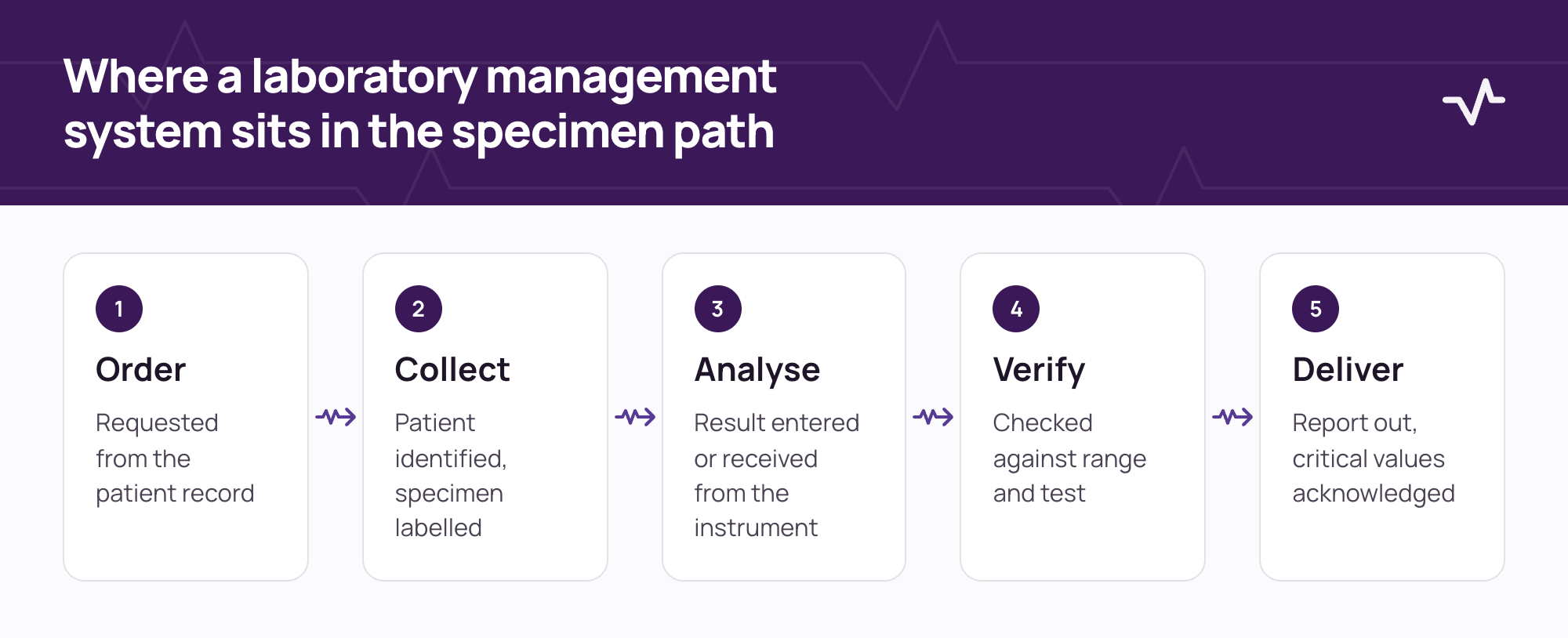
LIS, LIMS and laboratory management system: which name is right?
The terms overlap. In practice, LIS usually means software for clinical and diagnostic laboratories that report results on named patients, while LIMS (laboratory information management system) usually means software for research, industrial or testing laboratories that manage samples and batches. Laboratory management system is the plain-language phrase buyers use for either. If your laboratory reports results to doctors for named patients, you are looking for a LIS, whatever the vendor calls it.
The core functions
- Test and panel catalogue. Every test with its specimen type, result type, units and reference ranges, and the panels that group tests together.
- Orders and accession numbers. Each order receives a unique accession number that follows the specimen and the result.
- Specimen tracking. Expected, collected, received, rejected and disposed, with the person and the time for each change.
- Result entry and instrument import. Values typed in or received from an analyzer or middleware, and flagged against reference ranges.
- Verification. A result stays preliminary until a qualified person verifies it, and a released result is corrected by an amendment rather than overwritten.
- Critical-value handling. A defined route for results that need immediate action, with the acknowledgement recorded.
- Labels and reports. Specimen labels at the point of collection and a report the clinician and the patient can read.
- Audit trail and reporting. Who changed what, plus the turnaround and workload figures a laboratory needs to manage itself.
Where the controls matter most
| Step | What the system should enforce | What it prevents |
|---|---|---|
| Collection | The specimen is collected only after the patient is positively identified. | A specimen labelled for the wrong patient. |
| Reception | A rejected specimen needs a recorded reason, and a replacement can be requested from it. | Unsuitable samples lost without a trace. |
| Result entry | Values are checked against the reference range for the patient's age and sex. | Abnormal results that nobody flagged. |
| Verification | A result needs a value and an approved test before it can be finalised. | Release of incomplete or untested results. |
| Correction | A final result is changed only by an amended result, with a reason. | Edited results with no history. |
| Critical value | The notification stays pending until a clinician acknowledges it, and can then be escalated. | A dangerous result that nobody saw. |
How a laboratory management system connects to other systems
A LIS rarely works alone. It receives orders from the hospital or clinic record, exchanges data with analyzers or laboratory middleware, may send results to national or regional health information exchanges, and passes charges to billing. Each connection needs an owner, a message or file format and a test plan. The analyzer integration checklist lists the questions to settle for the instrument side, and the HL7 v2 guide explains the message format that many of these connections use.
Questions to ask before you choose one
- Is it built for patients or only for samples? Check that it handles patient identity, clinician orders and patient-facing reports, not only batches.
- Which of my specimen and result rules can it enforce, not just record? Ask to see a mismatch, a rejection and a correction.
- How are critical values handled? Ask who is told, how, and what happens if nobody acknowledges.
- How does it connect to my analyzers? Ask which instruments are already connected, and who builds and supports a new connection.
- Can it report in the languages my patients and doctors read? Check the printed report, not only the screen.
- What records will my assessor ask for? Laboratories working to ISO 15189 need records of identification, verification and corrections. Ask to see them produced.
- How is the catalogue controlled? Check who approves a new test or a change of range before it is used.
- How do we move from the current system? Ask for a plan that keeps the bench running, such as moving a laboratory without stopping the bench.
How Ventrecs Lab approaches it
Ventrecs Lab is the laboratory part of the Ventrecs platform. It works on the same patient record as the clinical, imaging and pharmacy modules, so an order, its results and the clinician who acted on them are linked rather than copied.
- Approved catalogue. Tests and panels are approved by the laboratory director before they can be used in production.
- Positive identification at collection. A specimen cannot be collected if the patient identification fails.
- Rejection with a reason. A rejected specimen records why, and a replacement can be requested from it.
- Verification and amendment. Results are preliminary until verified, and a correction creates an amended result with its reason.
- Critical results. Values beyond the critical limits for the patient's age and sex create a notification that the clinician acknowledges, and that can be escalated if it is not.
- Labels and reports. Specimen labels and wristbands print to Zebra network printers, and the verified result prints as a bilingual report with a QR code and a one-time PIN.
Connections to analyzers, middleware and national platforms are scoped, tested and supported per project. See Ventrecs Lab and the solution for independent laboratories.
Frequently asked questions
What is the difference between a LIS and a LIMS?
A LIS serves clinical laboratories that report results on named patients to doctors. A LIMS serves research, industrial and testing laboratories that manage samples, batches and methods. The names overlap, so check the workflow rather than the label.
Does a laboratory management system replace the hospital information system?
No. It handles the laboratory workflow. In a hospital it receives orders from the clinical record and returns results to it, and the two may be one platform or two connected systems.
What is an accession number?
A unique identifier given to a laboratory order. It follows the specimen, the results and the report, so every record can be traced back to one request.
What does result verification mean?
A qualified person reviews a result against the patient, the reference range and the test, and approves it for release. Until then it is preliminary.
Can a LIS connect to laboratory analyzers?
Yes, most can, usually by receiving results from the instrument or from middleware. The method depends on the instrument and the vendor, so agree the connection, the identifiers and the test cases before go-live.
Related Ventrecs pages
- Ventrecs Lab Specimens, results and instrument connectivity in one governed workflow.
- Ventrecs Connect The governed integration hub: monitoring, retries and reconciliation.
- Integrations How Ventrecs scopes, tests and supports each connection.
- Solutions by provider type Medical centres, laboratories, imaging centres, pharmacy groups and hospital networks.
Planning a deployment?
Tell us about your laboratory and current system. We can walk through the specimen path, the checks you need enforced and the instruments to connect.
More insights
- Laboratory analyzer integration checklist: what to define before connecting your LIS Most analyzer problems come from details nobody wrote down. Use this checklist to define each instrument connection before configuration starts.
- Moving a laboratory to a new LIS without stopping the bench A laboratory cannot pause for a cut-over. A phased plan, parallel running and reconciliation keep results flowing while the system changes.
- HL7 v2 explained: messages, segments and how hospital systems exchange them HL7 v2 is still how most hospital systems talk to each other. This is how a message is built, sent and acknowledged, and where interfaces go wrong.