Two kinds of exchange
The UAE has no single platform for health data. A provider usually meets two different kinds of exchange. Clinical exchange shares a patient's clinical record between facilities. Claims exchange carries eligibility, prior authorisation, claims and remittance between providers and payers. They are run by different programmes, use different formats and are onboarded separately.
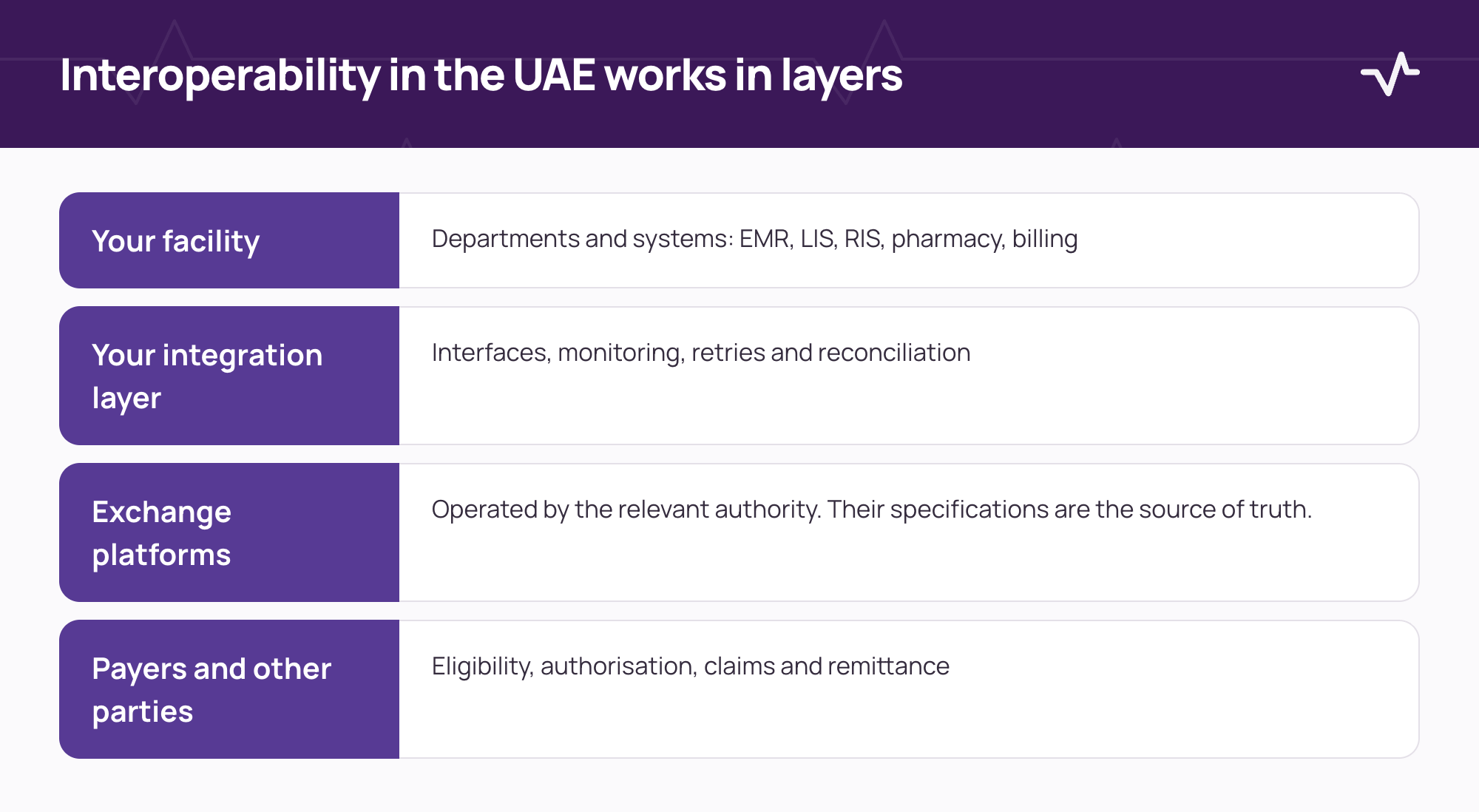
The platforms at a glance
| Platform | Where | Operated by | What it carries | What is published |
|---|---|---|---|---|
| Malaffi | Abu Dhabi | Abu Dhabi Health Data Services, for the Department of Health | Clinical data exchange | Facilities that must connect, onboarding requirements, connected-participant criteria: embedded access and real-time ADT messages |
| NABIDH | Dubai | Dubai Health Authority | Clinical data exchange | Interface documentation: HL7 v2.5 and C-CDA v2.1, message types, identifiers and code sets |
| Riayati | Federal, Ministry of Health and Prevention | Ministry of Health and Prevention | National unified medical record programme | Programme pages. We found no public technical onboarding specification for software vendors, so ask the ministry |
| Shafafiya | Abu Dhabi | Department of Health | Claims, prior requests and authorisations, remittance | Web services technical definition, XML transactions |
| DHPO and eClaimLink | Dubai | Dubai Health Authority | Claims, prior authorisation, remittance, electronic prescriptions | Provider manuals, XML schema, circulars and code lists |
The Ministry of Health and Prevention has announced an integration between Riayati, Malaffi and NABIDH. For a facility, that does not remove its own obligations: each facility still onboards with the authority that licenses it.
What the platforms have in common
- Onboarding is per licensed facility. Each facility, or the vendor acting for it, completes the authority's process. A connection built for one facility is not automatically valid for another.
- Identity. Patients are identified by Emirates ID where it exists, with passport or GCC identifiers as alternatives, and facilities are identified by their licence identifier.
- Standard codes. Diagnoses, procedures and medicines are coded to lists the authorities publish, such as ICD-10-CM, CPT, CDT and the Dubai Drug Code.
- Real-time events. Clinical exchange depends on events that are sent as they happen, such as admissions, discharges and transfers.
- Test before production. Each authority provides, or requires, a test stage before live traffic.
Planning for a group that operates in more than one emirate
A group with facilities in Abu Dhabi and Dubai integrates with two clinical exchanges and two claims platforms, and the same system may need to send different content to each. Decide early which parts are common and which are per emirate.
| Decision | Common to the group | Per emirate |
|---|---|---|
| Patient identity | One identity and duplicate control across facilities | Which identifier each platform expects |
| Terminology | One internal catalogue of services, medicines and diagnoses | The mapping to each authority's code lists |
| Clinical events | One source of admission, discharge, transfer, order and result events | The message set and test process of each exchange |
| Claims | One internal claim record with a lifecycle | The XML output and credentials of each claims platform |
| Operations | One monitoring and escalation model | Named contacts and environments for each authority |
A readiness checklist for UAE exchange
- A list of every licensed facility and the authority and platform each one connects to.
- A named owner for each clinical exchange and each claims platform.
- Patient identity rules for people without an Emirates ID.
- A mapping of your service, medicine and diagnosis codes to the authority lists, reviewed by the clinical owner.
- A source for real-time admission, discharge and transfer events.
- Test environments and named contacts requested early.
- Monitoring for rejected and missing messages, with a downtime procedure.
- A change process for when an authority updates its specification or code lists.
How Ventrecs approaches the UAE
Ventrecs separates the clinical system from the exchange. The hospital system records the events and the claim data. A governed integration layer, Ventrecs Connect, maps them to each authority's specification and delivers them through a durable outbox with retry, a transaction log and reconciliation.
Each connection is scoped per project, with the facility and the authority, and tested in the environment the authority provides. We do not claim that Ventrecs is approved by, or already connected to, any of these platforms. Our detailed guides cover Malaffi, NABIDH, and the Shafafiya and DHPO claims platforms.
Sources
- Malaffi: facilities required to connect
- NABIDH HL7 API documentation, Dubai Health Authority
- Riayati, Ministry of Health and Prevention
- Shafafiya, Department of Health Abu Dhabi
- eClaimLink, Dubai Health Authority
Frequently asked questions
Is there one health data platform for the UAE?
No. Abu Dhabi has Malaffi, Dubai has NABIDH, and the Ministry of Health and Prevention runs Riayati. Claims run on separate platforms: Shafafiya in Abu Dhabi and DHPO with eClaimLink in Dubai.
Does a facility connect once for the whole country?
No. Each licensed facility onboards with the authority that licenses it, and each platform has its own process and test stage.
Which standards are used?
Malaffi and NABIDH publish HL7-based exchange, with HL7 v2.5 and C-CDA v2.1 documented for NABIDH. Claims platforms use XML transactions.
What does Ventrecs claim about these platforms?
No approval or existing connection is claimed. Each connection is scoped per project and tested in the authority's environment before go-live.
Related Ventrecs pages
- Integrations How Ventrecs scopes, tests and supports each connection.
- Ventrecs Connect The governed integration hub: monitoring, retries and reconciliation.
- Solutions by provider type Medical centres, laboratories, imaging centres, pharmacy groups and hospital networks.
- Insurance and claims Payers, plans, pre-authorisation, eligibility checks and claims.
Planning a deployment?
Tell us which emirates and facilities you run. We can map the exchanges, the systems and the owners to agree before any connection is scoped.
More insights
- Malaffi integration guide: what Abu Dhabi facilities and EMR vendors need to prepare Malaffi is Abu Dhabi's health information exchange. This guide covers who must connect, what the onboarding asks for and what the EMR has to do.
- NABIDH integration guide: HL7 v2.5 and C-CDA for Dubai facilities and EMR vendors NABIDH is Dubai's health information exchange. This guide summarises what the Dubai Health Authority publishes for facilities and the EMR vendors who serve them.
- UAE e-claims explained: Shafafiya in Abu Dhabi and DHPO in Dubai Abu Dhabi and Dubai each run their own electronic claims platform. A hospital group in both emirates integrates with two systems, not one.