What Malaffi is
Malaffi is the health information exchange of Abu Dhabi. It is operated by Abu Dhabi Health Data Services for the Department of Health, and it lets licensed facilities share clinical information about a patient so that a clinician in one facility can see what another has recorded.
For a facility, Malaffi is two things at once: a source it sends clinical events to, and a viewer its clinicians open from inside the EMR.
Who must connect
Malaffi publishes the list of facility types that are required to connect, and the list of those exempt. Check your own facility type against the current list.
| Required to connect | Exempt |
|---|---|
| Hospitals | Military, police, aviation and university facilities |
| Medical, dental, one-day surgery and primary health care centres | Facilities that Malaffi identifies as sensitive or exceptional |
| General, specialised, dental, medical and school clinics | Drug stores, ambulance services and medical transportation |
| Imaging and laboratory diagnostic centres | Most rehabilitation specialities |
| Dialysis centres, IVF centres, pharmacies and home care services | Traditional and complementary medicine providers |
| Telemedicine providers of all types |
What the onboarding requires
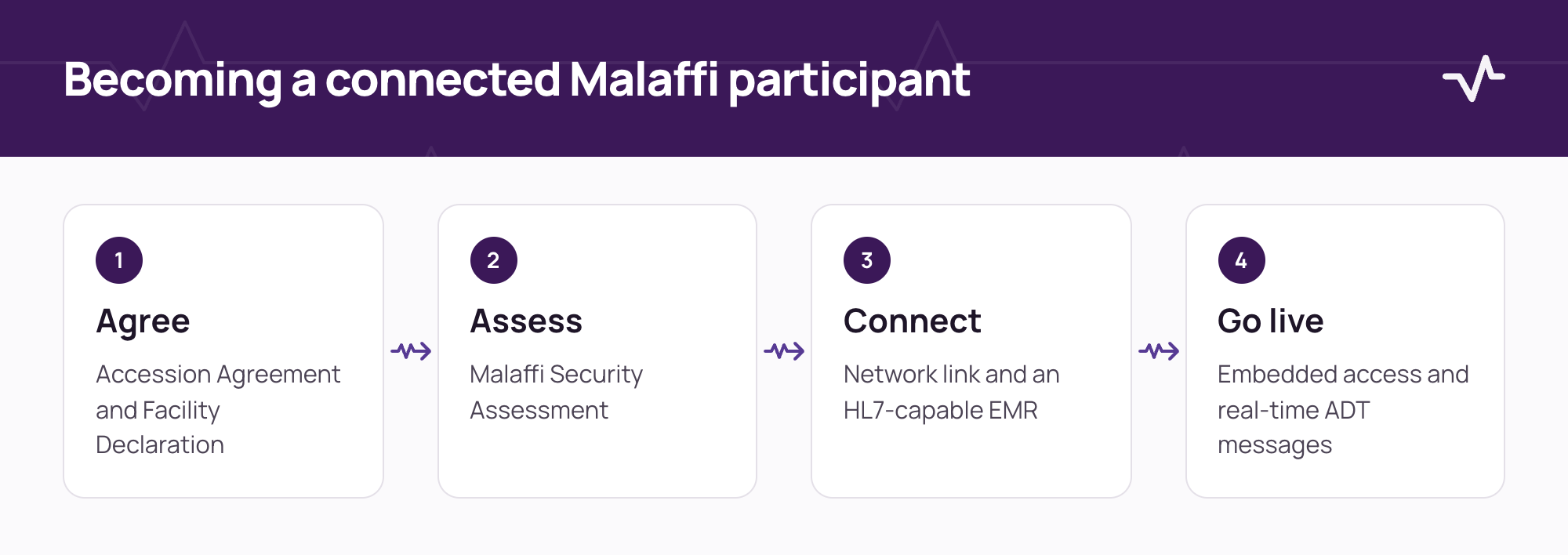
Malaffi describes onboarding as a series of steps that a participant follows to connect, and it can take several months depending on technical readiness. The published requirements to start are these.
- Agreements. Complete the Accession Agreement and the Facility Declaration, requested from the Malaffi onboarding team.
- Security. Pass the Malaffi Security Assessment.
- An HL7-capable EMR. The facility's EMR must be able to exchange HL7 messages.
- A network connection. Malaffi lists an SD-WAN connection from the telecom provider among the requirements.
A facility that holds a preliminary licence is advised to contact the onboarding team about two months before applying for its active licence.
What connected participant means
Malaffi distinguishes joining from connecting. A facility joins when it signs the Participant Agreement. It becomes a connected participant when it meets two criteria.
- Embedded mode. Malaffi is available as a link inside the EMR through single sign-on, so a clinician reaches it in one click without a separate login.
- Real-time ADT. The EMR exchanges admission, discharge and transfer HL7 messages with Malaffi in real time, when the event is saved in the EMR.
Go-live with Malaffi marks the moment a participant has connected successfully. The details of the message content, the test steps and any environment names are given to participants by the onboarding team, so ask for them at the start.
What an EMR has to do
| Capability | Why it matters | Question for the project |
|---|---|---|
| Admission, discharge and transfer events | They are the real-time trigger Malaffi requires | Does every movement raise an event the moment it is saved? |
| Patient identity | The exchange can only join records that identify the person consistently | Which identifiers does the EMR hold, and how are duplicates controlled? |
| Single sign-on link | It makes Malaffi part of the clinician's screen | Where does the link sit, and which user identity does it pass? |
| Coding | Shared data needs shared codes | Which diagnosis, procedure and medication codes are used, and who maintains the maps? |
| Monitoring | A silent failure means a clinician sees an incomplete record | Who is alerted when messages stop or are rejected? |
Questions to ask the onboarding team
- Which message types and trigger events must we send, and in which order?
- Is there a test environment, and what must be in place to access it?
- Which identifiers and code sets does Malaffi expect?
- How are errors returned, and what is the retry behaviour?
- Who signs off our test results, and what does the security assessment cover?
- What changes when we add a facility or change the EMR version?
How Ventrecs approaches Malaffi
The Ventrecs hospital system records patient movements, admissions, discharges and transfers, as part of the encounter, which is the source of the events Malaffi needs. It keeps enterprise patient identity with a duplicate-review queue, and clinical records with audit. A governed integration layer, Ventrecs Connect, turns events into the HL7 messages a partner expects, through a durable outbox with retry, a transaction log and reconciliation.
A Malaffi connection is scoped per project, together with the facility and the onboarding team, and tested in the environment Malaffi provides. We do not claim that Ventrecs is approved by, or already connected to, Malaffi.
Sources
- Malaffi: definitions, participants and connected status
- Malaffi: facilities required to connect and onboarding requirements
- Department of Health Abu Dhabi: Malaffi
Frequently asked questions
Who has to connect to Malaffi?
Most DOH-licensed facilities, including hospitals, clinics, diagnostic centres, dialysis and IVF centres, pharmacies, home care and telemedicine providers. Some categories are exempt, so check the current list.
What does connected participant mean?
The facility has made Malaffi available inside its EMR through single sign-on, and its EMR exchanges ADT messages with Malaffi in real time.
How long does onboarding take?
Malaffi says it can take up to several months, depending on the technical readiness of the participant.
Does Ventrecs have a Malaffi connection?
No claim is made. A connection is scoped per project with the facility and the Malaffi onboarding team, and the status is agreed before go-live.
Related Ventrecs pages
- Integrations How Ventrecs scopes, tests and supports each connection.
- Ventrecs Connect The governed integration hub: monitoring, retries and reconciliation.
- Ventrecs Care Patient identity, encounters and the clinical record.
- Solutions by provider type Medical centres, laboratories, imaging centres, pharmacy groups and hospital networks.
Planning a deployment?
Tell us about your Abu Dhabi facilities and your current EMR. We can map what has to be ready before the Malaffi onboarding starts.
More insights
- HL7 v2 explained: messages, segments and how hospital systems exchange them HL7 v2 is still how most hospital systems talk to each other. This is how a message is built, sent and acknowledged, and where interfaces go wrong.
- Healthcare interoperability in the UAE: a map of Malaffi, NABIDH, Riayati, Shafafiya and DHPO Interoperability in the UAE is shaped by more than one authority. Start by mapping which platform does what, and who owns it.
- NABIDH integration guide: HL7 v2.5 and C-CDA for Dubai facilities and EMR vendors NABIDH is Dubai's health information exchange. This guide summarises what the Dubai Health Authority publishes for facilities and the EMR vendors who serve them.