What NABIDH is
NABIDH is the health information exchange of Dubai, run by the Dubai Health Authority. It collects, aggregates, normalises and presents clinical patient data from the organisations that provide care, so that a clinician and, through a separate portal, a patient can see a unified record.
Facilities send patient data to NABIDH from their EMR as HL7 messages or C-CDA documents. The interface documentation, published by the Dubai Health Authority, describes how.
Which standards and messages it accepts
The interface documentation we reviewed, version 1.0 dated 19 July 2020, states that NABIDH supports HL7 v2.5 and C-CDA v2.1. Standards documents change, so confirm the current version with the Dubai Health Authority before you build.
| Standard | Message | What it sends |
|---|---|---|
| HL7 v2.5 | ADT | Admission, discharge and transfer information |
| HL7 v2.5 | ORM | New, cancelled, discontinued and held orders |
| HL7 v2.5 | ORU | Results and observations |
| HL7 v2.5 | RDE | Pharmacy and treatment orders |
| HL7 v2.5 | MDM | Document details such as discharge summaries, histories and procedure notes |
| HL7 v2.5 | VXU | Immunisation information |
| C-CDA v2.1 | ITI-41 and ITI-44 | Provide and register a document, and add or update a patient |
How a message is processed
A message from a facility passes through three layers before it reaches the exchange. At each stage it can be refused, and the sender receives an error.
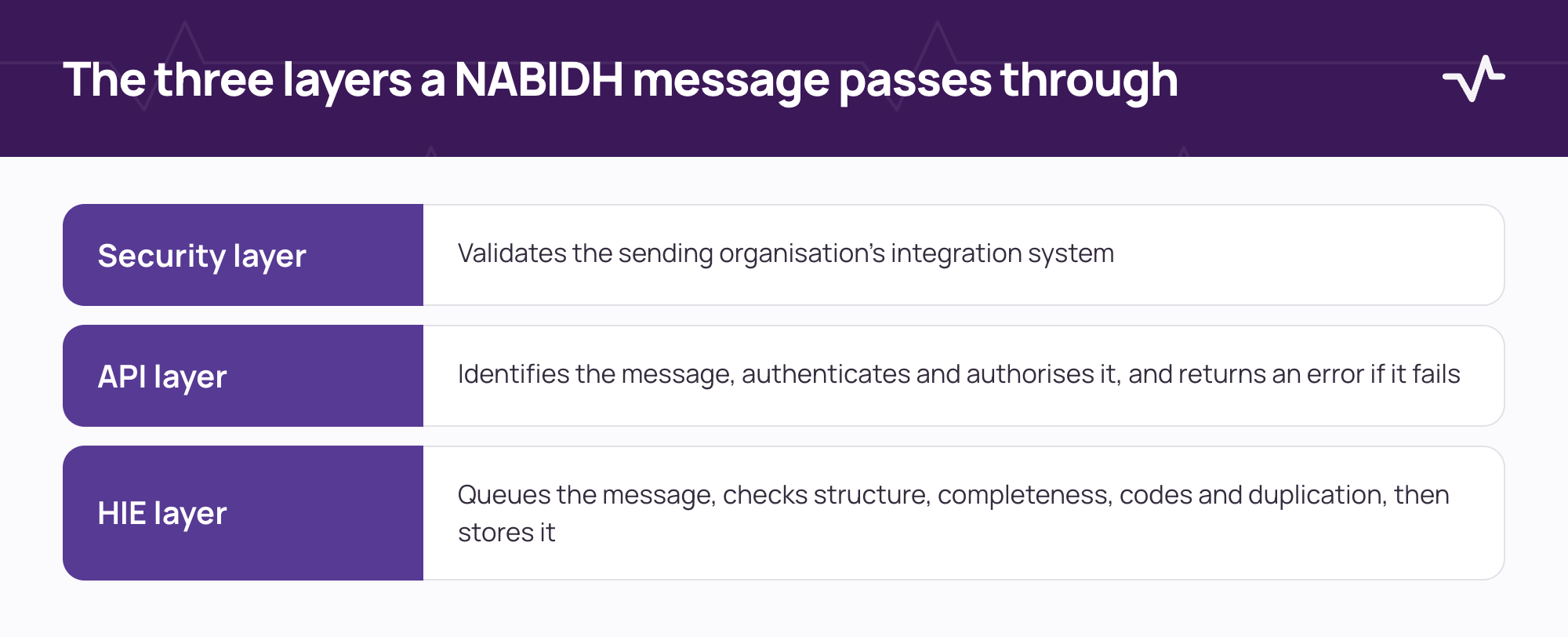
The commit acknowledgement values in the documentation are CA for an acknowledgement and CE and CR for negative acknowledgements. The sending system has to read them, and has to decide what to do on each.
Identifiers that must be right
The documentation is specific about identity, because a record that cannot be matched to the right person is useless.
- Sending facility. For a single-facility EMR, the sending facility is the facility's unique identifier in the Dubai Health Authority's licensing system. For a multi-facility EMR, it is the name of the EMR.
- Patient. The Emirates ID goes in the social security field and is validated for format. Where a patient has none, the passport number or the GCC number is used with a defined identifier type.
- Medical record number. The MRN is sent with an assigning authority, and secondary MRNs can be sent for search.
- Encounter and clinician. Every message with encounter information carries a unique encounter ID, and clinicians are identified by their identifier in the Dubai Health Authority's professional registry.
Code sets
The documentation points to the code lists that the Dubai Health Authority already uses for claims, so a facility that bills electronically already holds most of the mappings it needs.
| Data | Code set the documentation names |
|---|---|
| Diagnoses | ICD-10-CM |
| Procedures | CPT, and CDT for dental |
| Diagnosis related groups | IR-DRG |
| Medicines | The Dubai Drug Code |
| Country and nationality | The Dubai Health Authority code lists |
Privacy rules that change what you send
- VIP patients. No data for VIP patients, including documents and laboratory or radiology results, is sent.
- Tourists. Facilities flag tourist data so it is stored, with the opt-out available on the patient portal.
- Opt-out. When a patient opts out, the facility still sends the data, and it is not shown on the patient or the provider portal.
What to check before you build
- Written approval from the Dubai Health Authority to start onboarding, requested through the NABIDH application route it publishes.
- The current interface documentation, not an older copy.
- A list of the message types your EMR will send, with an owner for each.
- Identity rules for patients without an Emirates ID.
- A mapping of your codes to the Dubai code lists, reviewed by the clinical owner.
- A handler for negative acknowledgements, with a named person who reads them.
- A way to flag VIP and tourist patients and to honour opt-out.
How Ventrecs approaches NABIDH
The Ventrecs hospital system records the events NABIDH needs as part of the patient record: patient movements, orders, laboratory and imaging results, prescriptions and dispensing, discharge summaries and immunisations. It keeps patient identity at enterprise level with a duplicate-review queue, and it marks sensitive patients so that release rules can respect them.
A governed integration layer, Ventrecs Connect, turns those events into the messages a partner expects through a durable outbox, with retry, a transaction log and reconciliation. A NABIDH connection is scoped per project with the facility and the Dubai Health Authority, and tested before go-live. We do not claim that Ventrecs is approved by, or already connected to, NABIDH.
Sources
- NABIDH HL7 API documentation, Dubai Health Authority
- NABIDH policies and standards: interoperability and data exchange
Frequently asked questions
Which standards does NABIDH accept?
The Dubai Health Authority interface documentation describes HL7 v2.5 messages, namely ADT, ORM, ORU, RDE, MDM and VXU, and C-CDA v2.1 documents.
How do I identify a patient?
By Emirates ID in the defined field. Where there is none, the passport number or the GCC number is used with its identifier type, and the MRN is sent with an assigning authority.
Which code sets are used?
ICD-10-CM for diagnoses, CPT and CDT for procedures, IR-DRG, the Dubai Drug Code for medicines, and the Dubai Health Authority code lists for countries and nationalities.
Does Ventrecs have a NABIDH connection?
No claim is made. A connection is scoped per project with the facility and the Dubai Health Authority, and the status is agreed before go-live.
Related Ventrecs pages
- Integrations How Ventrecs scopes, tests and supports each connection.
- Ventrecs Connect The governed integration hub: monitoring, retries and reconciliation.
- Ventrecs Care Patient identity, encounters and the clinical record.
- Solutions by provider type Medical centres, laboratories, imaging centres, pharmacy groups and hospital networks.
Planning a deployment?
Tell us about your Dubai facilities and your current EMR. We can map the messages, the identifiers and the codes before any NABIDH work is scoped.
More insights
- HL7 v2 explained: messages, segments and how hospital systems exchange them HL7 v2 is still how most hospital systems talk to each other. This is how a message is built, sent and acknowledged, and where interfaces go wrong.
- Healthcare interoperability in the UAE: a map of Malaffi, NABIDH, Riayati, Shafafiya and DHPO Interoperability in the UAE is shaped by more than one authority. Start by mapping which platform does what, and who owns it.
- Malaffi integration guide: what Abu Dhabi facilities and EMR vendors need to prepare Malaffi is Abu Dhabi's health information exchange. This guide covers who must connect, what the onboarding asks for and what the EMR has to do.