What Wasfaty is
Wasfaty is an electronic prescription service in Saudi Arabia. The Ministry of Health introduced it in 2019 to connect hospitals and primary healthcare centres with community pharmacies, so that a patient can collect medicines from a pharmacy near them. It is managed by the National Unified Procurement Company, NUPCO, under the supervision of the Ministry of Health.
A 2024 qualitative study of pharmacists describes it as a system that links hospitals and primary healthcare centres with community pharmacies, and reports that it has improved the availability of medicines, especially chronic medicines in larger quantities.
How a prescription travels
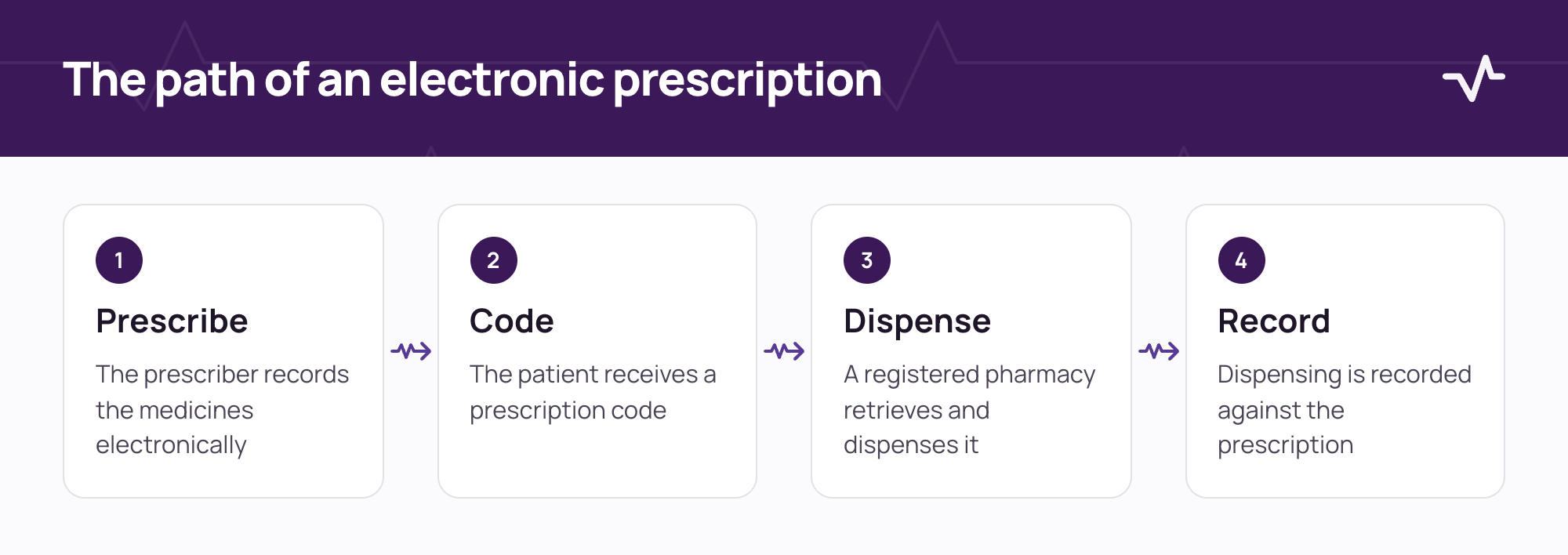
In outline, a prescriber records the prescription electronically, the patient receives a code, and a registered pharmacy uses it to retrieve the prescription and dispense. Public descriptions mention a code sent to the patient and presented at the pharmacy.
What pharmacies need to take part
Public descriptions of the service list requirements for a pharmacy that joins.
- Registration. The pharmacy is registered on the NUPCO platform as an accredited pharmacy.
- Licences. It holds a valid pharmaceutical facility licence, and its pharmacist is classified by the Saudi Commission for Health Specialties and holds a valid licence.
- Suppliers. It works with the accredited suppliers listed in the Wasfaty directory.
- Equipment. It has a computer with internet access, a barcode reader, a printer and medication instruction labels.
What we could and could not verify
We looked for public technical documentation, the kind that lets a software vendor connect a hospital or pharmacy system. We did not find any: no public sandbox, API specification or integration guide. That does not mean none exists. It means the information is not public, and access is arranged through the operator.
| Question | What we found |
|---|---|
| Is Wasfaty a national programme? | Yes. It is a Ministry of Health service managed by NUPCO |
| Who prescribes into it? | Hospitals and primary healthcare centres, as described by public sources |
| Who dispenses? | Registered community pharmacies that meet NUPCO's requirements |
| Is there a public API or sandbox for software vendors? | We found none. Ask NUPCO whether a system-to-system option exists and under which agreement |
| Which medicine codes and catalogues are used? | Not publicly specified. Ask for the current catalogue and its owner |
What your systems must be ready for
Whatever the connection looks like, e-prescribing makes the same demands on a hospital and pharmacy system. These are worth getting right first.
- A prescription that names the medicine by ingredient and generic, with route, dose and frequency as structured data, not free text.
- A medicines catalogue mapped to the one the programme uses, with an owner who reviews the mapping.
- A prescription lifecycle that a pharmacy can follow: issued, dispensed, partly dispensed, cancelled.
- Rules for controlled medicines, including who may prescribe and who witnesses dispensing.
- Batch and expiry recorded when a medicine is dispensed, and recalled stock blocked.
- Patient identity that matches the identifiers the programme uses.
- An audit trail of who prescribed, who changed and who dispensed.
- A downtime procedure for when the exchange is not available.
Questions to ask the operator
- Access. Is there a system-to-system option for hospital and pharmacy software, and what does it require?
- Specification. Where is the current specification, and how are changes announced?
- Catalogue. Which medicine catalogue and codes are used, and how are updates delivered?
- Testing. Is there a test environment, and who grants access?
- Responsibility. Who is responsible when a prescription cannot be retrieved or dispensed?
How Ventrecs approaches e-prescribing
The Ventrecs pharmacy module covers the parts of the workflow that e-prescribing depends on. Prescriptions are written with ingredient and generic search, routes and dose frequencies, and a controlled formulary. Dispensing produces labels, tracks batch and expiry and blocks recalled or quarantined stock at the moment of use. Controlled medicines need a witness who is not the person dispensing, and every step is audited.
A connection to a national e-prescribing service would be scoped per project, through the Ventrecs integration layer, once the operator provides its specification and access. We do not claim that Ventrecs is connected to, or approved by, Wasfaty.
Sources
- Wasfaty service, Saudipedia
- Pharmacists' experience of the Wasfaty service, Frontiers in Medicine, 2024
Frequently asked questions
What is Wasfaty?
An electronic prescription service of the Saudi Ministry of Health, introduced in 2019 and managed by NUPCO. It links hospitals and primary healthcare centres with community pharmacies.
Is there a public API for Wasfaty?
We found no public API, sandbox or integration guide. Access for software vendors, if offered, is arranged with the operator.
What does a pharmacy need to join?
Registration on the NUPCO platform, a valid pharmaceutical facility licence, a licensed pharmacist classified by the Saudi Commission for Health Specialties, and basic equipment including a barcode reader and a printer.
Is Ventrecs connected to Wasfaty?
No claim is made. A connection would be scoped per project once the operator provides its specification and access.
Related Ventrecs pages
- Ventrecs Pharmacy Prescriptions, dispensing, stock and POS across branches.
- Integrations How Ventrecs scopes, tests and supports each connection.
- Ventrecs Connect The governed integration hub: monitoring, retries and reconciliation.
- Solutions by provider type Medical centres, laboratories, imaging centres, pharmacy groups and hospital networks.
Planning a deployment?
Tell us how prescriptions are written and dispensed in your facilities. We can map what has to be in place before any e-prescribing connection is scoped.
More insights
- Multi-branch pharmacy software: managing dispensing, stock, expiry and POS A pharmacy group runs on branch-level stock and group-level control. Use this guide to check that software supports both.
- NPHIES integration guide: how FHIR R4 messaging works for Saudi providers and software vendors NPHIES connects Saudi healthcare providers and insurers through FHIR R4 messages. This is how the exchange works and what a hospital system has to be ready for.
- Healthcare integration readiness: scope every interface before go-live Most delays in a healthcare deployment come from interfaces nobody scoped. Use this guide to agree each connection, its owner and how it is tested before go-live.