Why a pharmacy group is harder than one pharmacy
One pharmacy can run on a good counter system and a careful pharmacist. A group has three tensions that grow with every branch: each branch needs to work independently, the group needs one view and one set of controls, and prescription rules must hold in every counter, not just the busy ones.
The common failure is stock that is accurate in one place and invisible in another. A branch sells a batch that another branch has already flagged as near expiry, or a recall cannot find where the batch went.
Stock: branch-level accuracy, group-level visibility
- Stock per branch. Quantities by batch and expiry date, not only by product.
- Transfers between branches. An in-transit state, and a check on receipt, so stock is never in two places or none.
- Reordering by branch. Reorder levels that reflect each branch's own sales.
- A group view. Total stock, value and expiry exposure across every branch.
- Counts. Cycle counts with reasons for each difference.
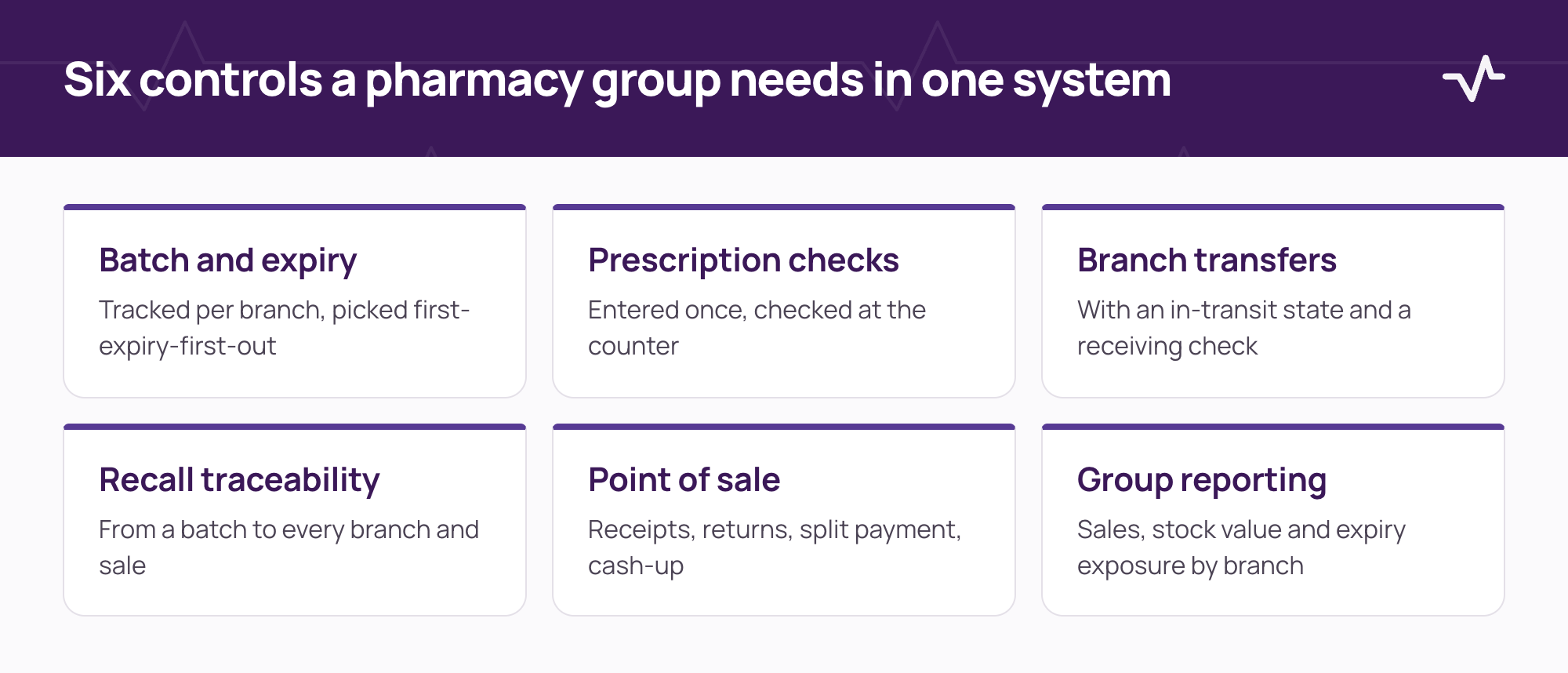
Batch and expiry control
Expiry is both a patient-safety issue and a cost. Software should pick the batch that expires first, warn when stock is close to expiry, let you quarantine a batch, and require a reason for a write-off. This only works if batch and expiry are captured when stock is received, not reconstructed later.
Prescription handling at the counter
A prescription should be entered once and checked where it is dispensed. Look for checks against the approved medicine list, handling of controlled medicines with the extra steps they need, and a clear difference between a prescription sale and an over-the-counter sale at the point of sale. Re-keying a prescription at the counter is both slow and a source of errors.
Recalls and traceability
When a manufacturer recalls a batch, you need answers in minutes: which branches received it, how much is still on the shelf, and who was dispensed it.
- Find a batch across every branch from one screen.
- Quarantine the remaining stock so it cannot be sold.
- List the sales or dispenses that included the batch.
- Record the actions taken, and by whom.
Point of sale and payments
- Receipts and returns that adjust stock correctly.
- Payments split between patient and payer where insurance applies.
- Cash-up at the end of a shift with differences recorded.
- Price lists that can differ by branch where they must.
Group reporting
Group managers need sales and margin by branch, stock value, expiry exposure, slow-moving lines and reconciliation of controlled medicines. If these reports need a spreadsheet to assemble, the branch data is not really in one system.
Controlled medicines and audit
Controlled medicines need stricter handling than other stock. Look for separate storage locations, a witness for dispensing and adjustments, running balances that can be reconciled at any time, and a record of every movement showing who did it and when.
Rolling out across branches
Roll out in a pattern you can learn from: one pilot branch, then groups of branches. Load stock with batch and expiry from the start, train counter staff by role, and agree how a branch operates if its connection is lost.
Questions to ask when evaluating
- Is stock held by batch and expiry per branch?
- How does a transfer between branches work, and what does the receiving branch confirm?
- How are near-expiry and quarantined batches handled at the counter?
- Is a prescription entered once and checked where it is dispensed?
- How are controlled medicines handled?
- Can a recall be traced from batch to branch to sale?
- How are insurance and patient payments split at the point of sale?
- What can a group manager see without a spreadsheet?
- How does the system behave when a branch loses its connection?
How Ventrecs Pharmacy approaches this
Ventrecs Pharmacy brings prescriptions, dispensing, stock and point of sale together under one control, so that stock and expiry are tracked per branch rather than per group, and a prescription is not re-keyed at the counter. It sits on the same patient record as the rest of the platform. See solutions for pharmacy groups for the deployment approach.
Frequently asked questions
What is FEFO in pharmacy stock control?
First-expiry-first-out. The batch that expires first is picked first, which reduces write-offs and the risk of dispensing close to expiry.
What should a pharmacy group track for each branch?
Stock by batch and expiry, transfers in and out, reorder levels, sales, returns and write-offs, so that each branch is accurate and the group can see them together.
Can prescriptions be entered once?
Yes, when the prescription lives in the same system as dispensing and stock. Then it is checked and dispensed without being typed again at the counter.
How should a recall be handled?
Trace the batch across branches, quarantine the remaining stock, list the sales that included it, and record the actions taken.
Related Ventrecs pages
- Ventrecs Pharmacy Prescriptions, dispensing, stock and POS across branches.
- Operations and Insights Beds, billing, stock and dashboards.
- Solutions by provider type Medical centres, laboratories, imaging centres, pharmacy groups and hospital networks.
- Integrations How Ventrecs scopes, tests and supports each connection.
Want to see this on your own workflow?
See how Ventrecs Pharmacy handles dispensing, stock and POS across branches, using your own workflow as the script.
More insights
- Hospital information system RFP checklist: how to evaluate HIS, EMR, LIS, RIS and pharmacy requirements A good RFP asks for evidence, not features. Use this checklist to define scope, requirements, demonstrations and scoring before you issue it.
- Healthcare integration readiness: scope every interface before go-live Most delays in a healthcare deployment come from interfaces nobody scoped. Use this guide to agree each connection, its owner and how it is tested before go-live.
- Laboratory analyzer integration checklist: what to define before connecting your LIS Most analyzer problems come from details nobody wrote down. Use this checklist to define each instrument connection before configuration starts.